Sunday, September 04, 2005


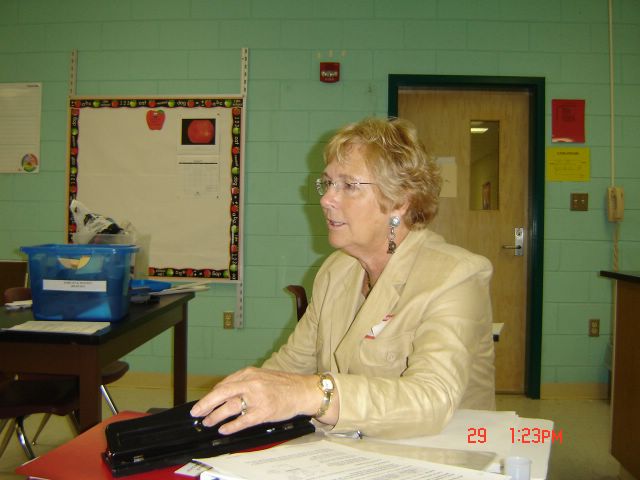
This is the state resource teacher that worked with us last Monday on the Physical Science curriculum. Contrary to previous experience, and to my delighted surprise, she was knowledgeable and experienced. The day-long session was terrific! Posted by Picasa

Sunday, August 28, 2005

PASSING MATH TESTS WITHOUT PAIN

The Viking Pundit has a reference to the MCAS (Massachusetts Comprehensive Assessment System) test. Having taught for a few years, I can believe that students found this problem difficult. Not surprisingly, one student found the question not to be a challenge:
Anandh Swaminathan, a junior at Acton-Boxborough Regional High School, was surprised to hear that half of his peers in the Commonwealth answered the question incorrectly. He didn't remember it as particularly difficult.

''It's a typical Algebra I problem," said Swaminathan, 15. ''It seems more straightforward. I actually thought that some of the other ones were harder."

Exactly. It's a problem that students would have been confronted with in the most basic Algebra course. So why the #$%^&*( can't they solve it?

Some math teachers think they have the answer:
Math teachers said the baseball question was a fair one, although puzzling to those unfamiliar with the sport.

''I certainly think our kids who are not speaking English as their primary language may not know the word grandstand or the word bleacher," said Debby Feldman, head of the math department at Brockton High School.

''When kids are reading a math problem and come up against words that are specific to a specific area and they don't know what they are, a lot of times it just freaks them out."

Oh, please. Anyone who has been in the country for less than a year may not know where in the stadium the seats are, but the context is clear - the problem is about seating, not location. For those delicate flowers who "freak out", I have just three words - GET OVER IT!

As the Viking Pundit likes to say:
there are three kinds of people in the world: those who can count and those who can’t.

Saturday, August 27, 2005

QUESTIONING AFTER THE ANSWER

I was teaching about density last week, and I used a technique I've been using a lot lately.

Students were able to calculate the density of various objects successfully. In the past, I would have moved on at that point.

This time, I posed the question:
What if I had half the mass and volume of the rice?

The silence that resulted indicated they hadn't made that leap to understanding that density is a ratio. It took several minutes of probing to get students to think about how they could reason through the answer.

I'm doing that additional questioning more this year. In the Physical Science class, I had been talking about the experiment of Galileo's that proved that heavy objects don'[t fall faster than lightweight objects (featherweight objects excluded).

Several students admitted that they didn't believe that heavy objects didn't fall faster. I congratulated them on their honesty, and pointed out that Galileo's conclusions were counter-intuitive. We resist the conclusion that seems to be contradicting common sense.

Tuesday, after I return from my workshop, I plan to use the demonstration that uses a large book and paper, first separately, then with the paper on top of the book (to eliminate air resistance). I'm assigning more observation and reflection writing with this year's students, and it seems to be helping them.

A USEFUL TIME-KILLER

I found a good site for math students looking for a challenge.

Planarity, which provides a neat puzzle, seen below.


The object is to move the vertices so that they do not overlap. There are multiple solutions, and it lends itself to a trial-and-error approach, which novice students might find useful.

Wednesday, August 24, 2005

MY NEW TECH

I have access to new technology this year. The department head has made the Quizdom set-up available to everyone (sign-up required), there's a digital microscope floating around (haven't made the time to check it out yet), and I have some CBLs and graphing calculators being sent as I post.

Not quite Nerdvana, but close.

BACK IN THE SWING OF THINGS

After less than 2 weeks, I feel back in the saddle. I've finally caught up with some of the preliminary paperwork that has been weighing me down, and I'm starting to have a few moments to refresh myself for the next day. Such as today - I actually had time to dip my toes into the blog world, and find out what people are posting about.

On Monday, I have a day of professional development with my fellow Physical Science teachers. Naturally, it's almost more trouble than it seems worth to prepare for the sub. The copying is handled centrally, so I need to be better prepared than I have in previous years (I have a tendency to wait until the last minute to get the copy ready). I currently have a busted overhead, so that's out. And I stupidly picked PERMANENT overhead markers - when shopping, I chose the right kind, then saw a better price. Didn't realize they were different until today. D'oh! As Homer Simpson says.

Still, for all the fish-out-of-water feeling I am experiencing, and the hassle of wanting some equipment that is still in Cleveland, and the loneliness of being without my husband - I am loving teaching full-time again.

It almost makes up for my anxiety about the NTE next month.

Sunday, August 21, 2005

FIXING THE WRONG PROBLEM

I've been following the discussions in several states lately (the advantage of having divided loyalties) on education. Everyone wants to improve it, but few can agree on how. One thing that definitely has an impact (it's true in any industry) - if the workers have a high turnover rate, that likely is trouble for the quality of the industry's product. Now, some get offended when the word "product" is used to refer to the educated end result of years of schooling. I understand - people aren't widgets. And one-size-fits-all solutions are also not likely to lead to long-lasting educational improvements. Take one popular solution - raising teacher salaries. Here's what Betsy has to say about that:
Take an example from my field: education. People complain that teachers are leaving the field. Polticians and teachers say that the solution is to increase teacher salaries. Well, I'm all for that. But what if that isn't the real cause of teachers retiring from the profession? What if it aggravation with administrators, nasty children, work overload, poor discipline procedures, nonsupportive parents, or any of a host of factors that could lead to loss of job satisfaction? If you increase the salaries and don't address the other problems, you haven't solved the problem. And you've taken money from a whole host of other areas to do so. How are journalists to find out what the real problem is? That's tough. I don't know. I've talked to many teachers who have decided to do something else and the reasons are many and varied. Sometimes the money was an issue, but often it wasn't. Teachers know what the salary is going in. It's the other stuff that can surprise them.

She has a point. We are aware that we are unlikely to get big bucks in teaching. There are compensations, like good benefits, protections against unreasonable firing, summers off (important for moms), and knowledge that the work is important, and makes a difference in the lives of children.

REMINDER OF THE OLD DAYS

Plaque for the Hampton Colored School.

Posted by Picasa

This is a marker for a restored building that was designated as the Colored School, pre-integration. The local high school is about 50-50 black & white today.

THE OLD COLORED SCHOOL

The Old Colored School, Hampton, SC

Posted by Picasa

Wednesday, August 17, 2005

THE DREADED PRAXIS

I've been informed that, due to the move to SC, I will need to take the PRAXIS II for Physics, Chemistry, and General Science.

When I heard that, I'll admit it, I panicked.

I was certified in OH as the last group of teachers that did not have the PRAXIS required. I'm probably admitting that I'm dumb, but I never thought that I would have to take a test at this late date.

Another teacher in my school hasn't passed it, either, so we're going to study the areas we're weak in (for both of us, Chemistry), and shore up any special topics we might need. Along with the usual grading, planning, and meetings (not to mention extra-curricular mandates).

I've since looked over the practice tests. Although they ask some challenging questions, most of it appears to be stuff I know. I do know this: if they ask me anything about equilibrium reactions, I'm going to assume I missed that question. There's no way a month's worth of cramming will prepare me for THAT!

Sunday, August 14, 2005

INNUMERACY

I've posted about Alliteracy (not INability to read, just a disinclination) before. A potentially bigger problem is INNUMERACY - inability to understand math.

Unlike alliterates, innumerates don't understand the basics; they can add, subtract, multiply, and divide (at least with a calculator), but they often have absolutely no clue when to perform which operation in real life. Hence, you have the problem of cashiers who cannot give proper change without prompting (and will unhesitatingly accept whatever the display tells them, no matter whether it makes sense or not), restaurant customers who cannot calculate the 15% tip (hint: try figuring out what 10% is, then adding half again as much), and even the large numbers of taxpayers who enrich the commercial preparers by paying for the 1040EZ to be filled out.

Many students confuse the process for entering division problems into a calculator with the procedure for hand-calculating them. In fairness, it's anti- the standard American practice of reading left to right.

Even more students (and their parents) have difficulty with understanding or using fractions and decimals. Too many elementary teachers are not totally comfortable with those functions - they can do it, but they can't coherently explain the process, and the mathematical reasoning for it.

One suggestion I've heard over and over again is - no calculators until at least middle school - some would raise that to high school. It's not that use of calculators mysteriously inhibits learning math, but that students' facility with the tool keeps teachers from learning who still doesn't understand the process.

Where, in this scenario, can technology fit?

Possibly, some of the better programs may be able to help students. I've heard good things about CAI programs such as Successmaker. At least in improving basic skills, they have been known to be of assistance.

However, too often, computer use in elementary and middle schools is a huge waste of time.
  • When researching, many students are uncritical consumers, blindly accepting the first few sites to pop up in a web search.
  • Often, teachers spend an inordinate amount of time monitoring students' activities, & keeping them from playing games, aimless browsing, and reading about sports, music, and tv/movies.
  • Most webquests are a joke, replete with factoids, trivia, and role-playing. They seldom are worth the time they take.
  • One exception to the general rule - The Jason Project is excellent. It is well designed, packed with activities that are aligned to standards (Science, Math, English, and Geography), and easy to use. It also has Student Journal, book reading and discussion forum, and teacher interactions. That last is important, as it gives inexperienced or isolated teachers the benefit of collegial feedback.

    One advantage to Jason is the training program - teachers are taken through the curriculm, and try out selected activities. Each year, teachers can return to learn about the new mission (it changes yearly).


What can be done if a student is behind 2 or more levels in math?
  • Thorough evaluation, followed by individualized program of remediation.
  • Use of a Mastery approach. Math is cumulative - failure to understand a basic concept leads to later failure, particularly when the math is taught via an integrated curriculum.
  • Grades should be Pass/Fail. "Effort" Ds are all too common. A "D" indicates that the student does NOT understand the concept.
  • Proficiency tests are a floor. If a student can't pass them, that indicates a serious problem. I've heard students say they "only missed passing" by 1 or 2 questions. EVERY students should pass these tests with room to spare.

Graduation should mean more than just barely managing to fulfill requirements.

Tracking has a bad reputation. Sorting students by presumed ability level is said to discriminate against miniorities.

I have an alternative suggestion: tracking by desire to learn.

All students who want to be in the highest-level, can.

There's just one catch - they can be dropped if they can't keep up. Any student in the lowest section of the class (1/4 to 1/3), must work extra (tutoring, before/after school assistance, CAI, online help, etc.).

What about the student who is chronically absent? What about them - if they work to keep up, they can stay. But if they can't cut it, good-bye.

This may sound harsh. But it's realistic. In high school, I had struggled with geometry, due to many absences (I had chronic brochitis, & was later diagnosed with asthma). Some things in life go to those that work harder. would American Idol contestants win if their performance was lacking, but they hadn't been well or had family problems or had a cold & couldn't hit the high notes? I think that's a major reason the "reality" shows are so popular - they don't take excuses for failure. They do't allow "do-overs".

In professional sports, it's similarly a game of survival of the fittest. Lebron doesn't get spotted a few extra points because he's jsut a kid.

If you play in the big boy's game, you play by the big boy's rules.

No exceptions.

Saturday, August 13, 2005

I'M BACK AT WORK, FULL-TIME

I'm in South Carolina, teaching science to 9th grade students. They are generally very nice, the teachers and the administration have welcomed me warmly, and I'm feeling cautiously optimistic about the future.

As I get acclimated, I'll try to post a few pictures of the surroundings - it's really lovely. Most of my spare time over the next month or so is going to be dedicated to making sure I'm prepared to teach. I moved down with virtually no equipment or supplies, so I will be improvising a lot.

Tuesday, August 02, 2005

Tom Senior demonstrating the use of his Light Fluctuation Detector (solar cell inside a cheap pen barrel). It works beautifully!

Posted by Picasa
Our PTRA host this year

Posted by Picasa
Mountains surrounding Salt Lake City, Utah

Posted by Picasa

Thursday, July 21, 2005

YOU'VE PROBABLY SEEN EXAMS LIKE THIS

On the Common Sense and Wonder blog, I found an exam. According to the blogger:
This is what happens on your final when you drink beer and party instead of studying all semester

SUPRISING SCIENCE, TECHNOLOGY, AND MATH PEOPLE

Winnie Cooper, the girl from The Wonder Years, is grown up and working as an actress. But, did you know Danica McKellar is also a math whiz?
Danica took a hiatus from acting for college, and she graduated from UCLA with a Bachelor of Science in Mathematics! While she was there, she even co-authored a math proof - new research proving an original math theorem - highly unusual for an undergraduate. In fact, she was the only undergraduate invited to speak at Rutgers University's biannual Statistical Mechanics conference a few years back. Although she has returned to acting full time, she still retains a passion for it, and likes to stay active.


Another surprise in his diversity of interests is Dolph Lundren, the action film actor.


Lundgren attended the Royal Institute of Technology. Spending time abroad in the United States on various academic scholarships, he attended Washington State University and Clemson in South Carolina. In 1982, he received a scholarship to complete his Masters degree in Chemical Engineering at the University of Sydney in Australia. The following year, he was awarded a Fullbright Scholarship to the world-renowned Massachusetts Institute of Technology.

BEAM ME UP

It's been an eventful summer.

First, for all those trekkies out there, the man known as "Scotty" has died. The Canadian-born James Doohan, the Enterprise's engineer, passed away at age 85 of pneumonia and Alzeheimer's.

Mr. Doohan's life was not uneventful, apart from the Star Trek series.
He was among the Canadian forces that landed on Juno Beach on D-Day. "The sea was rough," he recalled. "We were more afraid of drowning than the Germans."

The Canadians crossed a minefield laid for tanks; the soldiers weren't heavy enough to detonate the bombs. At 11:30 that night, he was machine-gunned, taking six hits: one that took off his middle right finger (he managed to hide the missing finger on the screen), four in his leg and one in the chest. Fortunately the chest bullet was stopped by his silver cigarette case.

Saturday, July 09, 2005

MID-SUMMER UPDATE

It's been an interesting summer, so far. I took a temporary job, which brings in immediate cash, but leaves me unable to take advantage of many summer workshops. OTOH, I do get to spend the day in air conditioning. The last few weeks, that was a definite advantage.

I am keeping busy, however. I've been posting to my other blog regularly. With all the activity happening in current events, there is much to comment on.

I've been learning how to draw Manga - it's a Japanese cartoon style. It's kind of fun to learn something so removed from other aspects of my life. I'd really enjoyed drawing when I was a kid, but, like so many of us, once I'd decided that I wasn't talented enough (how much is "enough"?), I gave it up. This time, the point isn't to satisfy someone else, it's just to make me happy.

Have a wonderful summer!

Sunday, June 19, 2005

CREATE YOUR OWN LEGO FIGURE

If you click on the titel of this post, you will find a page called Chris Doyle's Reasonably Clever.Com. He has an application there to create a customized Lego graphic, just like the one below.

My Lego Figure

Posted by Hello

Friday, June 10, 2005

Don't have room to store every poster? Try taking a picture of the end project.

Posted by Hello
Escher picture

Posted by Hello
When good chess pieces go bad

Posted by Hello

Tuesday, June 07, 2005

JUNE SITE OF THE MONTH


You have absolutely GOT to try this new game I found - it's the most addictive thing I've found in years.

Some of you will remember 24 - the math game that became very popular, both as a teaching tool, and because it's fun to play. Eventually, educational uses of the games led to tournaments.

This game is even better. Many of the puzzles can be completed in 10-30 minutes, so it's nice to have some puzzles available in the classroom for those students who finish a lab or project early. It doesn't require a partner, although students can team up to solve more challenging puzzles, so it lends itself to use in home schooling as well as classrooms.

According to the developers of the software version (pictured above),
Lots of puzzles and games teach you some kind of math. Such as simple arithmetic in parchisi, calculating the odds in backgammon, or combinatorial theory in poker.

Sudoku is different. It's not mathematical. It's one of the few puzzles and games that rewards Applied Logic. It encourages you to apply principles of deduction and induction – skills which you don't often get to exercise. It sharpens your powers of concentration and reasoning.
I'm not a player of most math games. I've never been very proficient at mental math, preferring to use pencil & paper to solve problems. I'm more of a visual processor, and need to literally see the problem laid out to get a handle on it.

But, this number game, I'm good at. Because it doesn't require me to juggle numbers in my head, it works with the way I think.

Tuesday, May 31, 2005

THE TRUTH HURTS

I was checking out a favorite blog, Critical Mass, a blog devoted to education. The question arose, how should writing be taught to ensure that students will become competent writers?

My belief, based on my experiences, is that nothing beats practice, practice, practice. You have to slog through the process of assigning the initial writing, marking it for errors, and helping students go through the correction and re-writing process.

It takes time. It takes effort. It takes some knowledge of the English language.

I have a small suggestion how teachers whose subject matter isn't English might approach the matter. Make an agreement that, each week, you will assign a short essay (3-5 paragraphs). You will provide the expertise about your subject (including spelling and usage), but the English teacher will correct for syntax, organization, and the like. If you share the load, students could get credit for both classes.

Too many students dash off the first draft, and assume that one pass at the assignment is sufficient. The essence of writing is re-writing.

Wednesday, May 25, 2005

ANOTHER USE FOR LEGOS

I found this cool use of Legos and CDs on Natalie Solent, a blogger who sometimes posts about technology issues.


The completed sextant

What can this sextant be used for? It fulfills the state objective for teaching about the early history of science, as well as giving students the opportunity to make an instrument that they can use to locate their position on Earth.


An early sextant

A good follow-up activity is to show them how to use GPS units.

Saturday, May 21, 2005

DON'T BE SHY - TELL US WHAT YOU REALLY THINK

WARNING - THIS LINK IS NOT WORK-SAFE. THE LANGUAGE IS OLD-FASHIONED, ANGLO-SAXON, AND VULGAR. IT ALSO IS HIGHLY INFLAMMATORY.

But the link is also funny, pointed, and from the heart.

The subject?
Have you ever wondered why colleges and universities have to offer remedial reading, writing and math classes?

The obvious answer is because your precious little gift to mankind is an idiot. That is the primary reason.

After that shot, the post gets REALLY straightforward. You may not agree, in full or in part, but I think it's worth reading.

Wednesday, May 18, 2005

MEETUPS

I'm waiting for a Meetup of the Cleveland Webloggers group. I just checked the site, I'm early - it's not until 7 pm.

So, I'll be using the time before the others arrive to update my blogs.


I'm still waiting to hear about the job, but, as it's 2 1/2 weeks since my interview, offhand I'd say that I didn't get it. They did say that they would be interviewing for 2 weeks, but my experience is that when you're the chosen one, you hear sooner.


I've been working on another business deal, involving ads for blogs. The idea is to aggregate many blogs, so the lesser-visited ones can also benefit from the arrangement. If you have a blog, and would like details, email me, and I'll send you information about it.

Sunday, May 15, 2005

SOME NEAT ANIMATIONS

I've been doing sound lately, and I found several sites with animations and information on the topic:


Have you ever found a site that irritated you? Made you wish you could wipe it off the face of the planet?

Well, now you can.

Netdisaster - Destroy the Web! is the answer to your problem. You enter the web URL, and select the disaster you want to befall the site. Among the choices are:
  • Slow burn
  • Dinosaurs
  • Nuke
  • Meteor shower

Have Fun!

Thursday, May 12, 2005

THE GREATEST USE OF TECHNOLOGY YET

OK, I know you've gotten used to the hyping of great technology from me, but trust me - this is ABSOLUTELY the greatest invention yet.

Tuesday, May 10, 2005

INSIDE THE SAUNA

This is the time of year that I HATE teaching.

Nothing to do with the kids, the job, or the parents - it's the fact that schools never seem to get the temperature level correct!

If the building doesn't have windows that can open, you can bet the air conditioning won't work.

If the windows should open, they'll be stuck shut. Or, like some at a school my husband taught at - fall out if you try to open them.

Worse, I was treated to display of skin that I didn't want to see - and that was just the student teachers!

I'm hoping that tomorrow is cooler.

Saturday, May 07, 2005

When lab partners go BAD! Posted by Hello
Not only fulfilling the instructions, but really pretty, too. Posted by Hello
Another approach to the set-up instructions Posted by Hello
One approach to the roller-coaster challenge. Posted by Hello

Friday, May 06, 2005

MAY WEBSITE OF THE MONTH

I found this gem on the Joanne Jacobs website. Though he is not a technology or science teacher, I selected it because he writes about his struggle to teach in terribly difficult circumstances in London, England:
Possibly the choicest, fruitiest discovery of the extended Easter break was realising I'd contracted worms from my delightful students.

Threadworms. Pinworms. Intestinal parasites.

Think about that.

At some quiet, unnoticed moment, these paragons of hygiene, this new model army of well-scrubbed cherubs have passed from their hands to my hands trace fecal matter, and I have gone on to ingest the stuff.

Ugh.

I need to say that again, just once. Ugh.

AN EXCEPTIONAL WOMAN

This is not technically related to teaching or education. It is the story of a VERY brave woman


who used the technology she had access to, in order to stand up for what was right:
During the tense days of Ukraine's presidential elections last year, Dmytruk staged a silent but bold protest, informing deaf Ukrainians that official results from the Nov. 21 runoff were fraudulent. Her act of courage further emboldened protests that grew until a new election was held and the opposition candidate, Viktor Yushchenko , was declared the winner...

Go - check out the link - you won't regret it.

Monday, May 02, 2005

HOW-TOS ON BLOGGING

I've been blogging for some time, but there's a lot I don't know. So, I appreciate it when someone explains how some feature or concept works.

The Mudville Gazette offers some pointers on blogging, including using Blogrolling to "ping" when you've updated your blog. Now, I'm sure that many more experienced bloggers know about this, but if I ever read it, I'd forgotten it. Apparently, without using a ping, those Blogrolls don't show the Update Message next to the link.

I can't wait until summer - I'm going to go into learning mode, and get up to speed on all the features of my favorite software and services. I know I'm going to learn how to do all the things I probably should already be doing, but just don't know are easily within reach.

Sunday, May 01, 2005

TOO IMPORTANT TO IGNORE

Normally, this blog is strictly non-political. I prefer to limit my posts to the technology and profession of teaching.

However, an action by the Association of University Teachers (AUT) of Great Britain, declaring a boycott of Israeli universities led me to make an exception.
The Council of the AUT -- a trade union and professional association for over 48,700 UK higher education professionals -- unanimously passed the two motions to boycott the institutions of higher learning at an executive union meeting held on the eve of Passover, evidently to deliberately exclude its Jewish members.

That action was not opposed, as
AUT executive president Angela Roger cut short the session and moved to deny a right of reply to opponents of the motions. The session was then directed towards a vote, and a "lack of time" was cited as the reason preventing challenges to the motions from being heard

Previous actions included discrimination against Israeli students, and
In July, two Israeli academics were fired from their posts at two linguistics journals as part of a larger boycott of Israeli academics and educational institutions.

Prof. Gideon Toury of Tel Aviv University and Dr. Miriam Schlesinger of Bar-Ilan University were removed from their posts by Egyptian-born Prof. Mona Baker of the University of Manchester Institute of Science and Technology.

Baker was one of more than 100 academics who signed a letter in The Guardian newspaper in April calling for a boycott of Israeli academics "until such time as the Israeli government abides by U.N. resolutions and opens serious peace negotiations with the Palestinians."

I believe that we need to act pre-emptively to forestall any similar actions by our professional organizations, and to go on record as opposing the AUT actions. Follow the links below to send a comment to your professional unions:

Or, you can add your support in an email to me, along with your professional affiliation, and I'll forward it to the appropriate group.

Friday, April 29, 2005

CROSSING MY FINGERS

I'm waiting to hear about the results of an interview; I really want the job. It would mean getting back into teaching Physical Science, and the excitement of a new program.

I've been trying to get my mind off the wait by looking over some Social Studies textbooks for middle school. They're pretty bad - too little text, too many meaningless pretty pictures, and jam-packed with inaccuracies, distortions, and implied untruths. Just dreadful, in other words.

When I finish my review, I'll post it here.

Tuesday, April 26, 2005

HOW NCLB WILL AFFECT YOUR STATE

I found this source of information about NCLB's impact on state education budgets. How does your state compare?

For teachers, the Department of Education site also provides the Teacher's Toolkit, which helps explain the provisions of NCLB, and how it could affect you, including information about becoming a Highly Qualified Teacher.

You can also get FREE (I love that word) video workshops on topics, including:
  • Math/Science

    Developing Computational Fluency in Addition and Subtraction

    Early Steps Count: Teaching Arithmetic to Prepare Students for Algebra

    Feedback: A Powerful Tool for Raising Student Achievement in Mathematics

    Measurement and Geometry: Building Conceptual Understanding in Young Children

    Patterns to Symbols: Algebra

    Standards-Based Differentiated Math

    Taking the "Dense" Out of Density

    Using Technology to Enhance Algebra Instruction

If anyone has any experience with these or other Teacher-to-Teacher workshops, email me with your take on them.

NO CHILD LEFT BEHIND, THE LATEST INFO

After a conversation with my daughter, a teacher-in-training, I checked out the current status of the No Child Left Behind act (NCLB). There have been some changes recently, including:
Secretary Spellings announced that the first example of this "workable, sensible approach" would be to apply the latest scientific research and allow states to use modified assessments for their students with persistent academic disabilities who need more time and instruction to make substantial progress toward grade-level achievement. These scores will be limited to 2 percent of all students for accountability purposes; this is a separate policy from the current regulation that allows up to 1 percent of all students being tested (those with the most significant cognitive disabilities) to take an alternate assessment.

Worried about an "unfunded mandate"? To help states implement these above changes,
Secretary Spellings also announced that she was directing an additional $14 million in immediate support for these students and that the Department would provide states with a comprehensive tool kit to help them identify and assess students with disabilities.

Yeah, but what about funding in general? Didn't the NCLB cause major expense for the states, without any additional money?
Federal resources have increased substantially during this period, including:

* An $8 billion, or 46 percent, increase for No Child Left Behind programs;
* A $10.3 billion increase in overall funding for federal elementary and secondary education programs;
* An increase of $4.6 billion, or 52 percent, for Title I Grants for economically disadvantaged students, which go directly to local education agencies—the key drivers of NCLB reforms; and
* A $4.8 billion, or 75 percent, increase for grants to states under the Individuals with Disabilities Education Act (IDEA) Part B.

Further,
The president's budget provides nearly $1.5 billion for this High School Initiative, and includes $1.24 billion for a High School Intervention initiative that would focus on strengthening high school education and providing specific interventions. The president's high school program also includes $250 million to help states develop and implement new annual High School Assessments in reading/language arts and mathematics by the 2009-10 school year.

The graph below shows the increase in federal money, which includes an especially significant increase, compared to spending under President Clinton:

Sunday, April 24, 2005


April 24th, Cleveland Posted by Hello

Thursday, April 21, 2005

STATISTICS, EXPLAINED

I've been a long-time reader of Number 2 Pencil, a blog by Kimberly Swygert. She's a Psychometrician, who describes her work:
My job is similar to other jobs in my field in that it requires a Ph.D. in Quantitative Psychology, Educational Measurement, or Psychometrics, and that my work requirements include both theoretical research and operational duties. Translated, that means I must spend time thinking up new ways of assessing people and also make sure that the current tests we use get administered and scored on time.

A feature that she's been periodically updating is explanations of common statistics terms and concepts, for example, this discussion of probabilities. Browse the archives, I've found the posts to be both entertaining and understandable to novices.

Tuesday, April 12, 2005

TRACKBACKS, EXPLAINED

NOTE: I was going to call this Trackbacks for Dummies, but, wisely, changed my mind when I considered that I was a Dummy until about 2 months ago.

Using trackbacks is not difficult, but it does take some time to set up. The major online trackback sources (HaloScan, WordPress, Movable Type, etc.) all use similar systems.

  1. Go to one of the above providers. I use HaloScan, so I'll use them as an example. You have to create an account.
  2. When you reference a blog using trackbacks, first create your post. If you use FireFox or a browser that allows tabbing, open a New Tab. Then, in that new tab, sign into HaloScan, and select Manage Trackbacks. The blog name and the blog's URL will be already filled in.
  3. At the bottom of your post will be the Permalink ? the permanent reference to the individual post. Copy that link, and switch to HaloScan. Paste the link in the 2nd field, Your Permalink URL. Put the Post Title in the 3rd field.
  4. Switch back to the post, and select an excerpt from your post. Copy and Paste into the 4th field, Your Excerpt.
  5. Go to the original post, and find the Trackback link. Copy, and Paste into the last field, URLs to Ping. Once you've done that, click on the Ping Now button. If the message returns as Success, you're done. Otherwise, you need to send another ping.

You will want to install the Trackback capability on your blog. By doing so, you can easily manage comments and references to your post.

TOO CUTE


Virtual Me Posted by Hello

I found this Online Lego Creator, and couldn't resist trying it out. Once you make your Lego person, you can save it, and add it to your website, Windows background, or screen saver.

Friday, April 08, 2005

THE PURPOSE OF EDUCATION

I've been pondering this question for some time - what is the purpose of education?

When I was a kid (I graduated in 1969 - no sleazy jokes, please, I've heard them all), most parents would agree that their school system's job was to prepare graduates for a good job. In the process, the schools would also provide some literacy, basic math skills, and some general knowledge. If the kid could handle all of these, they were considered educated.

At that time, most of my class did not intend to go to college. Among the middle-class, it just wasn't considered necessary. A few students of the middle to lower classes DID plan to attend, but they were generally very smart, and expected to be able to get some scholarship money.

The average student prepared himself/herself for work (or marriage) upon graduation. Many of the girls anticipated working for a year to two, until they married, and retired to raise a family.

In general, the schools did reasonably well. Even the kids on the lower-track levels could read, write, and handle math.

Guidance counselors had two basic functions - to help college-bound students get into their intended school, if possible, and to help everybody else get a job. Whether or not the student was happy or well-adjusted wasn't their problem.

I've been subbing, and, as I move from school to school, I've been asking questions of the staff, teachers, and counselors. The question:
What's the purpose of education?

I've gotten a wide variety of answers, including:
  • Get into college
  • Get a good job (definition varies)
  • Prepare students for the future (too often, fuzzy beyond that)
  • Various vague answers relating to happiness, fulfillment, and inner peace

I'm getting a feeling that too few people have a real sense of their educational goals. I'm now wondering about the educational organizations. What do they see as their mission?

The NEA (National Education Association) says that its mission is:
To fulfill the promise of a democratic society, the National Education Association shall promote the cause of quality public education and advance the profession of education; expand the rights and further the interest of educational employees; and advocate human, civil, and economic rights for all.


The AFT (American Federation of Teachers says:
The mission of the American Federation of Teachers, AFL-CIO, is to improve the lives of our members and their families, to give voice to their legitimate professional, economic and social aspirations, to strengthen the institutions in which we work, to improve the quality of the services we provide, to bring together all members to assist and support one another and to promote democracy, human rights and freedom in our union, in our nation and throughout the world.

--From the Futures II report adopted at the AFT Convention, July 5, 2000.

In all fairness, the 2 above organizations were designed to protect and advocate for their members - the teachers. What about the organizations that are "for the children" (I really hate that phrase, particularly as it is so often used as a cover for activities that do NOT benefit children, and, in fact, often make their lives worse).

From the National PTA:
To support and speak on behalf of children and youth in the schools, in the community and before governmental bodies and other organizations that make decisions affecting children;
To assist parents in developing the skills they need to raise and protect their children;
To encourage parent and public involvement in the public schools of this nation.

From the National Association for the Education of Young Children
NAEYC's efforts are designed to achieve these ends:

1. All children have access to a safe and accessible, high quality early childhood education that includes a developmentally appropriate curriculum; knowledgeable and well-trained program staff and educators; and comprehensive services that support their health, nutrition, and social well-being, in an environment that respects and supports diversity.
2. All early childhood professionals are supported as professionals with a career ladder, ongoing professional development opportunities, and compensation that attracts and retains high quality educators.
3. All families have access to early childhood education programs that are affordable and of high quality and actively participate in their children's education as respected reciprocal partners.
4. All communities, states, and the nation work together to ensure accountable systems of high-quality early childhood education for all children.

The above 2 programs seem to be more focused on providing professional support for the schools, than on the issue of whether or not kids actually learn.

So, who speaks for the kids? It would appear to be no one.

Educational purpose was addressed thusly:
It seems to me that education has a two-fold function to perform in the life of man and in society: the one is utility and the other is culture. Education must enable a man to become more efficient, to achieve with increasing facility the legitimate goals of his life.

Education must also train one for quick, resolute and effective thinking. To think incisively and to think for one's self is very difficult. We are prone to let our mental life become invaded by legions of half truths, prejudices, and propaganda. At this point, I often wonder whether or not education is fulfilling its purpose. A great majority of the so-called educated people do not think logically and scientifically. Even the press, the classroom, the platform, and the pulpit in many instances do not give us objective and unbiased truths. To save man from the morass of propaganda, in my opinion, is one of the chief aims of education. Education must enable one to sift and weigh evidence, to discern the true from the false, the real from the unreal, and the facts from the fiction.

The function of education, therefore, is to teach one to think intensively and to think critically. But education which stops with efficiency may prove the greatest menace to society. The most dangerous criminal may be the man gifted with reason, but with no morals.

The writer? Martin Luther King, Jr., 1948, Morehouse College.

A specifically Christian viewpoint is here.

From the Maharishi's website
The purpose of education is to culture the mind of a man so that he can accomplish all his aims in life. Education, to justify itself, should enable a man to use the full potential of his body, mind and spirit.


From what I've seen on the web, the people who most often express a stated purpose for education are those who come in from a religious perspective. Non-religious statements tend to be of the wishy-washy, feel-good type, that vaguely state something about how "students will realize their potential" and "become a good citizen (usually adds "of the world").

Their potential for what? Ted Bundy, Johnny Cochrane, and Abraham Lincoln all trained to be lawyers, but they used that training in different ways.

Good citizens? Osama bin Laden, Sandy Berger, and Martin Luther King, all of whom broke laws, did so for different purposes, and had different outcomes.

I think we need to begin thinking about what our educational purposes are, and aim our work at that goal.

Wednesday, March 30, 2005

HELLO + PICASA


This is an example of using whiteboards in classes. I'm using this picture to test out the BloggerBot feature of Picasa.
With Hello + Picasa, publishing pictures on Blogger is really simple and easy. Posted by Hello

Posting pictures to a web site, particularly a blog, can be frustrating. For a long time, the only pictures I placed on any of my blogs came from other sites. The problem with that is that those sites pay the cost of the increased bandwidth for each time a viewer loads the page. Naturally, the original site would prefer that other pages soak up their own bandwidth, particularly if the referring page gets a lot of hits.

Picasa is software that facilitates finding, editing, and displaying graphics. It really is easy to use. When first started, it finds and loads any graphic format into an Explorer-type window. You can add to those pictures by Importing from a camera, scanner, or other media. They can be viewed as a slideshow. The Timeline is neat, since it organizes your pictures by date (which, for pictures that are taken with a camera, separates them by event, more-or-less).

You can create a CD with a slideshow with a single button (Gift CD).

Sending the photos to a webpage or Hello can be done with a single Action button. First, select any pictures you want to be able to post. Then, select either the Blogger button, or select the Action button next to the selected pictures, Send to Hello choice.

Hello is a web service. You'll need to create a username. When you first open it up, you login. Then another window pops up, and the actions you need to take are not obvious.

From Hello, move the slider, and click on the gray-out thumbnails until the one you want to post is displayed in the tray. You will find that the insertion point appears in the caption box, lower right of the screen. This is where you type your text. Once that's completed, click on the left button of the box to Send.

Where will they go? If you're like me, and have multiple blogs, you will need to adjust the Settings (button bar at the top). When you click it, the Blogger screen shows. You can either use the blog displayed in the drop-down box, or select another. The first time you use Hello, you will sign into Blogger, and select a blog. After, you will post to the default blog, unless you select another.

You can adjust other settings from there, including size of picture, caption placement, borders, and attribution.

It doesn't always work. Sometimes, due to network issues, you need to re-send (button next to the Send button). When you do, the frustrating thing is that you have to type your caption again.

What will post to the blog? The picture sent will be displayed in a single post. That post will have no title, so, if you want one, you will need to edit the post. You will probably will want to do that anyway, to add other commentary to that post. I've done that with this post. To see other pictures I've posted, go to my Family News blog.

I highly recommend this software. It's a free download; just select Hello + Picasa.

Wednesday, March 23, 2005

REQUEST FOR ASSISTANCE

I'm compiling a list of suggestions and comments on how science teachers can improve pass rates on the graduation tests. If you have any lessons/ideas/labs you want to share, Email Me with the info, attachment, or link, and I'll post a round-up of all submissions.

OHIO GRADUATION TEST

I've linked to the Ohio Department of Education web page that references the new Science Academic Content Standards. Over the next few weeks, I hope to provide more information about how the graduation test will affect the classroom teacher, and how to best help students achieve a passing (or better) score.

I'm adding a new feature - the Educator Website of the Month. April is the first month, and it's fitting that I'm spotlighting a long-time educator whose site is absolutely amazing - and full of useful resources, including demonstrations and lesson plans he has developed.

Heck's Physics is the offspring of Dick Heckathorn. Richard Heckathorn is a Physics Teacher at Cuyahoga Valley Christian Academy. He has long been a leader and mentor in science education at the local, state, and national levels.

Among the awards he has received are:
Jennings Scholar 1965 - 1966

Shell Merit Fellow
Cornell University
Summer 1969

Presidential Award
Excellence in Science Teaching
Ohio - 1987

Distinguished Teacher
Berea City School District
2002

His publications include:

"On Selecting a New Text" - Physics Teacher, Vol 20, No.8 (5527) 1982)
"What Do I Really Expect of a Physics Laboratory Manual" - Physics Teacher, Vol 22, No.4 (226) (1984)
"An Evaluation of High School Physics Laboratory Manuals" - Physics Teacher, Vol 22, No. 4 (222-226) (1984)
"A Density Demonstration" - Physics Teacher, Vol 25, No. 1 (39) (1987)
"Retraining Teachers in Physics" - Physics Teacher, Vol 28, No. 4 (230-231) 1990
"Twice Yearly Column" - Ohio Section of AAPT Newsletter, (1984-2001)

Dick's accomplishments are many, and would take up considerable space. I urge you to explore Heck's Physics site ASAP.

Tuesday, March 22, 2005

BACK IN TOWN AGAIN

I did have to go out of town for a funeral. As deaths go, this one was easy - relatively quick, just like the person had told everyone she wanted. Her expressed wishes were followed to the letter.

It was also a quality experience, as the extended family all gathered for several days of food, consolation, and family story-telling. They're of Irish heritage, so those stories were fueled by coffee and Irish whisky. The wake was memorable and noisy, just like we like it.

One of the grandchildren is a bagpiper, so she received a wonderful send-off.

I'll be posting again by tomorrow, when I catch up on sleep.

Thursday, March 17, 2005

HAPPY ST. PATRICK'S DAY!

Go to Google, and check out the cool logo in celebration of the day.


This is a link to the story of St. Patrick.

Here's a link to a History Channel video giving some background on St. Patrick.

Also from the History Channel, An Irish Quiz and a Quiz on the History of Ireland.

MAJOR CHANGES IN PROGRESS

I've been thinking about this site, and I've decided to make a major overhaul. It won't interrupt access, I'm going to make those changes over the next few weeks, a little at a time.

I'm going to pose a question for you to think about:

What would an Ideal School look like?

Email me with your thoughts, and I'll post a round-up later.

Saturday, March 12, 2005

VERNIER UPDATE


I saw the new Go! Motion in action today at the Ohio Section of the American Association of Physics Teachers meeting, and it looks slick.

The setup is easy (plug into the USB), the cost is low ($ 99.00, no additional parts needed), and the software is Logger Lite (shown displaying the Go! Temp data below.


Another great science toy presented today was the World Wind software. In the words of the NASA site


World Wind lets you zoom from satellite altitude into any place on Earth. Leveraging Landsat satellite imagery and Shuttle Radar Topography Mission data, World Wind lets you experience Earth terrain in visually rich 3D, just as if you were really there. I've placed a sample screen shot below.

Wednesday, March 09, 2005

TECH THAT'S NOT-SO HIGH

When we think of technology, there is a tendency to limit ourselves to the high end of the tech. But, there is a great deal of science that can be best learned from low-tech applications.

Crystal radio is one of those low-tech apps. Despite advancements in radio - transistors, solid state electronics, and satellite broadcasts, to name a few, building a crystal radio provides a way for students to understand the fundamentals of communications and wave physics.

This link will take you to a page that makes an argument for including Crystal Radios into science classes, as well as including links to plans, kits, lessons, and community resources.

Friday, March 04, 2005

I'M REALLY ASHAMED OF MYSELF, BUT THIS IS FUNNY

OK, this link is a low blow at Whole Language advocates, but it's really funny.

Time and time again, the phonics-based methods and Direct Instruction have been studied, and shown to be better than Whole Language.

Time and time again, these promising methods have been jettisoned from the curriculum. The reasoning varies, but it generally includes complaints that the methods "stifle creativity" in teachers.

Would that it were true - some overly flaky approaches should be stifled.

Thursday, March 03, 2005

REALLY TRIVIAL, BUT VERY CUTE

OK, I know it shows my frivolous side, but I couldn't resist linking to this picture. There's a grain of truth here - my son played chess on a computer for several years, before ever playing a live human.

His first tournament, he won.

Tuesday, March 01, 2005

LOCAL RESOURCE IN SCIENCE

I wanted to remind all teachers that we have a truly great resource in science education in the greater Cleveland area, the Cleveland Regional Council of Science Teachers. They will be having a Spring Symposium on Thursday, April 14th, from 4:00 to 7:00 pm.

Dr. Mano Singham, director of the University Center for Innovation in Teaching and Education (UCITE) and adjunct associate professor of physics at Case Western Reserve University will share research findings and information from his experience in working with teachers and their students for many years in the Cleveland area.

Dr. Singham will share insights from his work with teachers in the Discovery program and will provide a preview of material in his new book, “The Achievement Gap in U. S. Education: Canaries in the Mine” which will be published in May.

The structure of the evening will be:

* 1 hour lecture
* 40 minute light supper and formulation of questions
* 45 minute Q & A session with Dr. Singham

A Light supper (Catered by Verba’s) will be served.

If you email me, I'll send the flyer with registration details.

MARCH UPDATE

I haven't been posting lately, because I've been busy with family and job issues.

What's happening:
  • My daughter had the baby - a boy last week.
  • I've been working at Emerson, for a teacher out on back surgery. It only lasts about two more weeks, then it's back to day-to-day subbing.
  • My asthma has had another flare-up, leaving me in the hospital over the weekend. I'm fine now, just a little behine in everything.


I was at a workshop on Saturday on flight. You can find out information on this link.

Apparently, the curriculum (which I had an opportunity to examine - it was great!) was sent to all schools in the Ohio systems. You may want to check with your district's science supervisor or director of curriculum. It may be buried somewhere at the administration building.

Or, you could bookmark this link. They will be coming out with a DVD by summer, which they intend to supply for a small price (less than $10) to educators.

Wednesday, February 16, 2005

PLAYING WITH MY NEW TI-84+

I've been using my graphing calculator in NoteFolio mode with the keyboard. It actually works fairly well, but I notice that I have made more typos than I normally do. I'm not sure if it's the touch of the keyboard, or my tendency to hit the keys hard.

While playing around, I found
a really cool use for a calculator - Making a Robot.

Is that cool or what! I already have some robot stuff, so I don't think I'll be doing it soon, but it looks like a truly geeky and fun activity.

If you decide to do it, please send the pictures to me.

Friday, February 11, 2005

NEW TECHNOLOGIES

I recently took a tour of St. Mark's school in Cleveland. They've installed several interactive whiteboards. The staff referred to them as "SmartBoards", but, they are another type offered by Promethean. The teachers have been trained extensively, and they are quite proficient in using the technology.

Among the features available:

  • Pre-prepared lessons on a variety of topics
  • Ability to create interactive lessons
  • Videoconferencing
  • Ability to link to internet sites
  • Remote control of the whiteboard


These technologies provide ways to use one computer with an entire class, while allowing more control over how the technology is used than multiple computers do.

Wednesday, January 26, 2005

A VERY EFFECTIVE TOOL FOR STOPPING AIMLESS WEB BROWSING

Click on the Title of this post to find a page that helps focus your concentration on the work at hand. I found this link thanks to Alpha Patriot. In addition to the tool for focusing effort, there is a lengthy article about procrastination, and how to thwart it.

Sunday, January 23, 2005

WHAT'S SO GREAT ABOUT BLOGS? PART 2

I still have trouble explaining to friends and family what the excitement about blogs is all about. I decided that I needed to list my thinking in some kind of an orderly way.
  1. Web page are static, blogs are dynamic.

    I didn't actually come up with this wording; another student in my graduate technology class did (can't remember his name). What it means is, that a web page is designed to be a finished, highly polished jewel, to be admired for the ages.

    A blog, in contrast, is a quickie scrap materials & glue project, meant to serve a purpose for a short time, then tossed in a drawer (or a wastebasket). That a given post may survive and be referenced for a long time is a quirk of the medium - electrons are cheap to store.

  2. Books, and even magazines and newspaper have limitations on entry. Only a few can see their words in print, due to the cost of the medium.

    Blogs, in contrast, are the equivalent of the street corner - open to all, no matter how deluded.

  3. The ability of anyone to set up a blog means that ANYONE does - the talented and interesting, as well as the tediously boring. However, I tolerate them better, since I don't pay for them, unlike print material.

  4. Publishing is undergoing a real revolution, not unlike the change in the days of Gutenberg. The cost of publishing has made it possible to bypass the elitist gatekeepers.

    It also has the potential to light a fire under students. As never before, they have the ability to leapfrog past the editorial eye of their teachers, and seek their audience on the Web.

    There's nothing like knowing that what you've written has been read by someone who doesn't have to read it. Whether or not they agreed with it, approved of it, or enjoyed it is immaterial.

    With this technology, what could English classes become?

IF I KNEW THEN WHAT I KNOW NOW

This is a classic post, from a person, Paul Graham, who I've never linked to before, although I will now.

The question he answers is, what advice would you give to high school students from the distance of your life experiences today?

He talks about the root cause of boredom in teens:
And when I was eight, I was rarely bored. Give me a back yard and a few other kids and I could play all day.

The reason this got stale in middle school and high school, I now realize, is that I was ready for something else. Childhood was getting old.

I'm not saying you shouldn't hang out with your friends-- that you should all become humorless little robots who do nothing but work. Hanging out with friends is like chocolate cake. You enjoy it more if you eat it occasionally than if you eat nothing but chocolate cake for every meal. No matter how much you like chocolate cake, you'll be pretty queasy after the third meal of it. And that's what the malaise one feels in high school is: mental queasiness.


He talks about college admissions:
It's dangerous to design your life around getting into college, because the people you have to impress to get into college are not a very discerning audience.


I've just given a amall taste of the richness of this essay. Go there, enjoy. Devour and savor.


Feel free to write your version of this essay in the comments.

Friday, January 21, 2005

ADVICE FROM A TECH-SAVVY TEACHER

I've been checking out more resources available to teachers. The number one question I'm often asked is is how I learned to work on computers. I think Rosemary Shaw, in this article from TechLearning expresses it best.

Saturday, January 15, 2005

YET ANOTHER STUPID, BUT FUN, IDEA

I was wondering the 'net, and on A Small Victory (warning - not work safe), I found an acronym generator quiz. Well, naturally, I couldn't resist, and generated the following

TTender
EEntertaining
CCharming
HHuge
NNerdy
OOrganic
LLoud
OOrderly
GGraceful
YYoung
IIntense
NNice
TTame
EElitist
AAmbitious
CCute
HHardworking
IInnocent
NNaughty
GGood

Name / Username:


Name Acronym Generator
From Go-Quiz.com

Wednesday, January 12, 2005

NERDINESS

I ran across this test on Accidental Verbosity. My result are:

I am nerdier than 77% of all people. Are you nerdier? Click here to find out!


I think it says something about myself that I scored higher on this than the 800-question Nerd Test I took 10 years ago. I'm not sure what it says, though.

Saturday, January 08, 2005

SOME NEW LINKS

I've been checking around, and teachers and others involved in education have caught the blogging fever. Right now, interest seems to fall into two categories:
  • Those who write about technical aspects of the technology
  • Those who write about how it's used in schools

I tend to be one of the latter. I'm most interested in how a technology can be used to foster learning, improve communication, and make teachers' jobs easier. Some of the blogs I've found lately:
  • LORE: An E-Journal for Teachers of Writing. This is not just for Language Arts teachers. With the current emphasis on writing across the curriculum, this is of interest to all.
  • EduBlog Insights. This blog is both enthusiastic and insightful (as its name would suggest).
  • Teachnology. This is apparently a post-secondary teacher with an interest in education.

COMMUNICATIONS ON THE WEB

Weblogg-ed posts about the social aspects of the Internet. I think this is an often-overlooked feature of the technology. Think of the ways that the Internet fosters interaction:
  • Instant messaging
  • Email
  • Listservs
  • Videoconferencing
  • Blogging
  • Distance Learning

The funny thing is, school districts are terrified about that very thing. They often make it as hard as possible for spontaneous interactions to occur, even banning some of the above activities. Unless the activity is scripted or moderated, they don't want it.

And that's a true shame. In my experience, it's the spontaneous hook-ups that most often lead to a true educational moment. I favor giving kids the tools (age-appropriate, and with oversight), and letting them use them. Yes, I know that kids will initially need a lot of monitoring (particularly their language, which is often not even PG), and, yes, I know that there will need to be supervision to prevent them from contact with predators, but that's true for most activities involving kids.

Rather than clamp down on all kids, single out the ones using inappropriate language, and send them a personal message (like, I know this is how you talk normally, but I believe that you can do better than this). If necessary, kick them off for a few days, longer if they don't learn the lesson. But, don't keep all kids from accessing the power of the web because of a few. It's better to teach them how to use it properly.

Tuesday, January 04, 2005

BLOGS HIT THE MAINSTREAM

Blogging in educational circles is reaching the level of critical mass - it's not just for the techies. The blogging tools are widely available, the expertise needed is well within the reach of the average user, and its benefits for both students and teachers has been demonstrated over time.

Educational blogs range from commentary on education Joanne Jacobs, a writer who specializes in educational issues, graduate students and professorsJenny D. and Winston's Diary, an adjunct, and classroom teachers Ms. Frizzle, Behind the Desk, and I Am a Teacher, who is currently working as a substitute (as am I).

Some Links about Blogging:

Tuesday, December 28, 2004

TRY OUT THIS TECHNOLOGY

If you have the ability to download on your system's computer, I suggest that you try Mozilla's new Firefox browser. I have been using it exclusively for the last few months (starting with the beta version), and I have noticed that the problems of pop-ups and annoying ads don't occur. I'm told by my son-in-law (who is our home network guru) that the security puts Microsoft products to shame.

I also love the ability to create tabs in a single window. They're easier to close when I want to return to the previously open tab than the multiple windows in IE or Netscape.


I've experienced no difficulty with viewing any sites. It doesn't appear that incompatibilities are much of a problem. Either that, or website developers are getting savvier about not using browser-specific tags.


There's also a new email viewer, called Thunderbird, that many are calling an "Outlook killer". I haven't tried it - I generally use my Yahoo account, or Popmail.

In general, the Open Source software that I've tried is functional and easy to use (Open Office, Linux, Firefox, etc.). I must caution, however, I don't generally push the envelope. I'm a lazy user - if the software does 80-90% of what the commercial product does, I'm satisfied with it. Minor differences don't bother me.

Tuesday, December 21, 2004

CHRISTMAS BREAK

I'm on vacation for the next 2weeks. After that, I don't know right now. I'm of the belief that, right now, the most important quality for a teacher is to be flexible. The employment situation is tight, improvements in class sizes or pay seem unlikely, and most districts are operating in no-frills modes.

On the positive side, it's nearly Christmas. My kids are nearby or staying with us for the holidays, my extended family is healthy, and I'm baking cookies with my daughters today.


Merry Christmas to all, and to all, a Good Night!

Tuesday, December 14, 2004

FUNDING SOURCES

I've been researching sources of funding for professional development. The following places, I've found, explain a little about ESEA (Elementary & Secondary Education Act), and other grant sources. I think I need to pick someone's brains about the specifics of how I help districts get the money for workshops and training.


I fear that I will need to become engulfed in the jargon and esoterica of the grant world to be able to make this happen. Well, if I have to, I have to.

Thursday, December 09, 2004

WHY BLOG?

Blogs have hit the recognition level. People outside of the blogging community have heard of them (and perhaps even started following one), but they have difficulty seeing the utility of them. I've talked to many teachers about blogs, even urged them to use them as a way of updating parents and students about the happenings in their classroom. But, few have responded. They don't perceive the value as great enough to justify the steep learning curve.

Over the next few months, I'm going to re-visit this issue on multiple occasions. I use blogs, I read other people's blogs, and I am passionate about their potential for education. I will be spotlighting my favorite blogs, posting about tips and techniques that are easy-to-use, and generally promoting their use in education.

JUST IN TIME FOR THE HOLIDAYS

I'm telling everyone I know about this:
"Yellow ribbons tied around trees and red, white and blue
stickers on the backs SUVs saying "Support our Troops"
are things that make civilians feel good but do nothing
for the men and women actually in uniform.

So please consider the following:

The number ONE request at Walter Reed hospital is phone cards. The government doesn't pay long distance phone charges and these wounded soldiers are rationing their calls home.


Locally, some inexpensive places to get phone cards are - Marc's, Walmart, and Target.

So, while you are trekking around town, picking up things for your loved ones, consider adding a phone card (any size) to your purchases, and sending it to:

Medical Family Assistance Center
Walter Reed Medical Center
6900 Georgia Avenue, NW
Washington, DC 20307-5001

You won't be sorry.

UPCOMING BREAK

The "Winter Break" is fast approaching, and it's likely that the overload of responsibilities will make updates less frequent. I should be back by January 3rd, if not sooner.

Merry Christmas, and a Happy and Prosperous New Year!

Tuesday, December 07, 2004

HOW MUCH TIME IS ENOUGH?

I often have workshop participants comment on how much I know about a particular technology. At first, I was more than a little embarassed about it, protesting that I wasn't all that knowledgeable.

Over time, however, I came to realize that my knowledge base WAS larger and more comprehensive than many other teachers, at least in the area of technology. I eventually came to some conclusions about the time I spent, and what other people were willing to do to further their expertise.

On the average, I spend 5-10 hours a week either online, reading about technology topics, attending workshops, testing out hardware and software, and otherwise keeping myself up-to-date on technology. That's in addition to preparing to present workshops, taking classes in the summer, and attending seminars and conferences.

All that is W-A-A-A-y more than the average teacher. So, it's perhaps not surprising that I can use the technology more effectively. On the other hand, many teachers spend more time on lesson planning than I; the quality of their planning shows in the lessons. I also am terrible about keeping up-to-date on the grading. I need to budget more time for formal feedback via corrected papers.

In the end, you get better in the areas that you focus on. For me, it ends up being the tech.

IT'S NOT JUST THE K-12 SCHOOLS

On the blog University Diaries, you will find this link to the University of Michigan student newspaper:
PROFESSORS STRUGGLE TO BRING
HIGH-TECH TEACHING AIDS
INTO UNIVERSITY CLASSROOMS

So, why, with the equipment so readily available in the college classroom, are so few professors using it?
Of the 184 professors surveyed, 24 percent said they didn’t have the time to learn the technology. Twenty-seven percent said they didn’t know about the benefits, 17 percent said the technology was inappropriate for their classes and 23 percent said it wasn’t worth using.

It sounds as though schools are much the same at every level. Relatively few experienced teachers will change radically what they have been doing all along.

I've found that to be true in the corporate world as well. Unless an employer mandates use of the technology, only the few who enjoy being on the cutting edge will learn new tricks.

This will change 2 ways:
  • New teachers will bring in a different skill set, one that includes a certain comfort with the technology
  • Teachers will adopt technology if they can see what the benefit to them will be (WIIFM - What's In It For ME). One strong motivator is a reduction in time spent doing a task. Another is if using the technology brings them recognition as an educational leader.

GIFTS FOR GEEKS

I found these gifts on the Wired Magazine website.

Some gift mugs with a science theme.


A tote that's literally out of this world! Made with materials that were on the space station.


The Science Mall

This site contains items I've never seen anywhere, such as the Meteorite Pendant.

WEATHER IN XML FORMAT

This area of technology is not one that I'm the most expert on, to say the least. However, many teachers have weather stations, and it looks as though the National Weather Service is going to have their data available in a more user-friendly format. That will, of course, affect the commercial services that have traditionally served as a filter for the publicly-funded program's data.

From what I can see, it may be worth your while taking the time to become familiar with the format, particularly for the Biology and Earth Science teachers. I'm just making the decision that it's not worth it for me, personally.