I found a really funny, if somewhat snide reflection on the mania to ensure that all students will feel really, really special and smart.
To be candid, I feel that most teachers, myself included, grade students more leniently than a realistic appraisal of their learning would mandate. In part, that is because most districts no longer officially separate students by ability. With all students taking college prep coursework, the teacher either has to be overly generous with grades, or risk failing large segments of the class.
Tuesday, June 13, 2006


Monday, May 22, 2006
Elementary, my dear Watson!
I found this on Science and Politics

# It is a capital mistake to theorize before you have all the evidence. It biases the judgment.It was prompted by Google's celebration of the anniversary of Sir Arthur Conan Doyle's birthday.
# I never guess. It is a capital mistake to theorize before one has data. Insensibly one begins to twist facts to suit theories, instead of theories to suit facts.
Hooray for technology!
I had a relatively pleasant time getting my final grades in today. It was simple to add in the score for the Finals - I did the test in Quizdom, and didn't have to manually score anything. I plan to use United Streaming quizzes next year, as well. I understand they can be done online.
Next year's Physical Science students are already excited about taking the class. They kept on seeing the neat equipment I had set up for the other classes (they were in Applied Biology this year), and wanted to know how to use it. They were particularly interested in the PASCO motion detectors.
Today, I went to a training session on United Streaming. I already used it, so wasn't sure I would benefit. It was worth the time I took, as I learned about new features, and features I wasn't currently using. I also found out about the Discovery Educators Network, which I plan to join. It seems worth the time.
Next year's Physical Science students are already excited about taking the class. They kept on seeing the neat equipment I had set up for the other classes (they were in Applied Biology this year), and wanted to know how to use it. They were particularly interested in the PASCO motion detectors.
Today, I went to a training session on United Streaming. I already used it, so wasn't sure I would benefit. It was worth the time I took, as I learned about new features, and features I wasn't currently using. I also found out about the Discovery Educators Network, which I plan to join. It seems worth the time.
Friday, May 12, 2006
Free at Last - Almost!
I'm down to the last week and 1/2. I have to finish the grading this weekend, and enter the grades in the computer. Next week, other than working with a few kids who need to make up an assignment, I only have my finals. Finals finish on the following Monday.
That's basically it. I'll use those last two half days to useunpaid labor cooperative, fine youngsters to clean, organize, and run errands. Assuming they'll show up, when the attendance won't be taken.
That's basically it. I'll use those last two half days to use
Friday, April 28, 2006
HQ - At Last!
It was the last, long day of a VERY long week - the upperclassmen were testing, in SC's version of an exit exam. Which meant, for the 9th grade, extra time in some of their classes, with no ability to let loose some steam roaming the halls.
Yesterday, it came to head - about 20 girls cut loose with a water balloon fight just after lunch. Today, the 9th grade is on punishment - escorted to lunch like toddlers, no privileges.
So, when I checked onto the state certification site, I fully expected to see that I'd still not been approved for a full professional certificate in science.
And I really needed it. The deadline for applying for National Boards is Monday. Without a change from temporary permit to certificate status, I couldn't apply.
Whoopee!! Hot diggity dog!!! It was approved, and I'd been marked an HQ - a Highly Qualified teacher. Which also made my principal and district very happy.
I got online as soon as the kids left, and finished the application. Then, I filled out the paperwork for the state payment of the processing fees.
Right after I left, it was off to the bank to get the papers notarized, and then to the post office to have them postmarked in time.
Sometimes, life is good. Very good.
Yesterday, it came to head - about 20 girls cut loose with a water balloon fight just after lunch. Today, the 9th grade is on punishment - escorted to lunch like toddlers, no privileges.
So, when I checked onto the state certification site, I fully expected to see that I'd still not been approved for a full professional certificate in science.
And I really needed it. The deadline for applying for National Boards is Monday. Without a change from temporary permit to certificate status, I couldn't apply.
Whoopee!! Hot diggity dog!!! It was approved, and I'd been marked an HQ - a Highly Qualified teacher. Which also made my principal and district very happy.
I got online as soon as the kids left, and finished the application. Then, I filled out the paperwork for the state payment of the processing fees.
Right after I left, it was off to the bank to get the papers notarized, and then to the post office to have them postmarked in time.
Sometimes, life is good. Very good.
Sunday, April 23, 2006
Web Word Processor
I found an interesting new application. It's one of the first web applications that has the potential to be a Microsoft Killer.
AjaxWrite. I've been playing around with it, and come to a few conclusions:
I'll probably continue using it for a few months. I'll be traveling part of the summer, and it would be nice to have compatibility with my Open Office files. In addition to a word processor, there are other applications shown. Don't know how good they might be, I couldn't get the Image editor to load. It may have been a network thing. The Spreadsheet Viewer is just that. It only allows you to see, not edit.
My evaluation? Not ready for prime time. But promising. I'll check back at the end of summer.
AjaxWrite. I've been playing around with it, and come to a few conclusions:
- It's still in the early development stages. I tried using it to create a sign for my door, but I had difficulty getting it to print in the enlarged font correctly. The font displayed correctly, but the text ran off the edge of the page. I finally added some hard returns, and it printed fine. So, it's not fully WYSIWYG yet.
- I can see the utility, particularly when you're not at your home machine, but need to work on something. You save your work either to a website or a jump drive, and can theoretically work on it whenever, whereever.
- At the moment, it's a stripped-down version of the old Microsoft Works. Some of the "functions" are greyed-out, indicating that they're not available. Not sure why.
- It only works in Firefox, version 1.5 or higher. Fine for me, I prefer Firefox.
- No spell-checker at the moment. No way to change page layout. No insertion of images, yet. So, it's still a VERY baby version. Ajaxwrite needs to ramp up, soon, if they don't want to get clobbered by The Evil Empire.
I'll probably continue using it for a few months. I'll be traveling part of the summer, and it would be nice to have compatibility with my Open Office files. In addition to a word processor, there are other applications shown. Don't know how good they might be, I couldn't get the Image editor to load. It may have been a network thing. The Spreadsheet Viewer is just that. It only allows you to see, not edit.
My evaluation? Not ready for prime time. But promising. I'll check back at the end of summer.
Web Word Processor
I found an interesting new application. It's one of the first web applications that has the potential to be a Microsoft Killer.
AjaxWrite. I've been playing around with it, and come to a few conclusions:
I'll probably continue using it for a few months. I'll be traveling part of the summer, and it would be nice to have compatibility with my Open Office files. In addition to a word processor, there are other applications shown. Don't know how good they might be, I couldn't get the Image editor to load. It may have been a network thing. The Spreadsheet Viewer is just that. It only allows you to see, not edit.
My evaluation? Not ready for prime time. But promising. I'll check back at the end of summer.
AjaxWrite. I've been playing around with it, and come to a few conclusions:
- It's still in the early development stages. I tried using it to create a sign for my door, but I had difficulty getting it to print in the enlarged font correctly. The font displayed correctly, but the text ran off the edge of the page. I finally added some hard returns, and it printed fine. So, it's not fully WYSIWYG yet.
- I can see the utility, particularly when you're not at your home machine, but need to work on something. You save your work either to a website or a jump drive, and can theoretically work on it whenever, whereever.
- At the moment, it's a stripped-down version of the old Microsoft Works. Some of the "functions" are greyed-out, indicating that they're not available. Not sure why.
- It only works in Firefox, version 1.5 or higher. Fine for me, I prefer Firefox.
- No spell-checker at the moment. No way to change page layout. No insertion of images, yet. So, it's still a VERY baby version. Ajaxwrite needs to ramp up, soon, if they don't want to get clobbered by The Evil Empire.
I'll probably continue using it for a few months. I'll be traveling part of the summer, and it would be nice to have compatibility with my Open Office files. In addition to a word processor, there are other applications shown. Don't know how good they might be, I couldn't get the Image editor to load. It may have been a network thing. The Spreadsheet Viewer is just that. It only allows you to see, not edit.
My evaluation? Not ready for prime time. But promising. I'll check back at the end of summer.
Saturday, April 01, 2006
One thing that Americans excel at
I was reading Watching America, a site where you can get translations of foreign news. I highly recommend it, as it's always neat to see yourself (and your countrymen) from the perspective of non-natives.
Today, I found an interesting article that lauds the way Americans teach their children about money and personal responsibility. It particularly mentions the Girl Scout cookie selling program:
Today, I found an interesting article that lauds the way Americans teach their children about money and personal responsibility. It particularly mentions the Girl Scout cookie selling program:
The Girl Scouts Web site [RealVideo] flatly states that many successful American entrepreneurs got their start selling Samoas and Tagalongs [cookies]. Each box of cookies costs four dollars, which is at least 30% higher than the store price. Such a way to teach a child to make money! Isn't it a little too much? But as soon as we tried to sell our first box, I saw that no one was put off by the price.The American experience is contrasted with the Chinese way of raising children.
American children are truly very practical, and begin to make and calculate money from childhood. They all realize the value of money early on, and don't neglect even a penny.The article additionally mentions that American children are more conscious of others' needs, and spontaneously give to others in need, without parental prodding.
Monday, March 27, 2006
Emergency in Project-Land!
I just got off the phone with my daughter. Her son had a last-minute crisis with a project due - you could see this coming - tomorrow!
Fortunately, it was a science research project, and I was able to clarify the terms that were causing confusion - habitat, community, niche, and population.
That's why I seldom assign projects. It seems to cause more work for the parents than for the kids. When I do hand out projects, I try to assign them so there are points where I check the progress, and can assist in re-directing effort in more productive channels. One of the few I think worthy are science fair projects. But, only if I have the kids bring in their work-in-progress to make sure they stay on task.
Fortunately, it was a science research project, and I was able to clarify the terms that were causing confusion - habitat, community, niche, and population.
That's why I seldom assign projects. It seems to cause more work for the parents than for the kids. When I do hand out projects, I try to assign them so there are points where I check the progress, and can assist in re-directing effort in more productive channels. One of the few I think worthy are science fair projects. But, only if I have the kids bring in their work-in-progress to make sure they stay on task.
Dress Codes - Good or Bad?
The school I work at has a new push to enforce the dress code. It mandates some overly stringent rules:
OK, I'm a little sarcastic today. But, I just sat in a meeting about the dress code, and, from my perspective, it's a very reasonable set of rules. But some of the teachers were up in arms. They said that they would have to spend too much time enforcing it (come on, maybe 10 minutes the first day, less thereafter). They claimed it would take away from time they needed to prepare for the End of Course Tests (mandated by the state). After a few teachers voiced their opinions, I noticed something - most of the teachers who were anti-dress code enforcement weren't the snappiest dressers on the faculty.
I've had to abide by a dress code before. The teachers had to follow one, as well as the kids. It was not a problem. I got used to wearing dress shoes instead of athletic shoes. Other than that, my wardrobe needed little polishing. But, I used to work for businesses, and there, I assure you, I had to dress according to the dictates of my employers.
Many teachers began working just as the custom of dressing up to go to work was ending. Many of them got used to dressing very casually. I've known teachers (yes, certified teachers) to wear:
But not flip-flops.
- Shirts must be tucked in
- Pants must be worn at the natural waist
- No flip-flops
- No hats
OK, I'm a little sarcastic today. But, I just sat in a meeting about the dress code, and, from my perspective, it's a very reasonable set of rules. But some of the teachers were up in arms. They said that they would have to spend too much time enforcing it (come on, maybe 10 minutes the first day, less thereafter). They claimed it would take away from time they needed to prepare for the End of Course Tests (mandated by the state). After a few teachers voiced their opinions, I noticed something - most of the teachers who were anti-dress code enforcement weren't the snappiest dressers on the faculty.
I've had to abide by a dress code before. The teachers had to follow one, as well as the kids. It was not a problem. I got used to wearing dress shoes instead of athletic shoes. Other than that, my wardrobe needed little polishing. But, I used to work for businesses, and there, I assure you, I had to dress according to the dictates of my employers.
Many teachers began working just as the custom of dressing up to go to work was ending. Many of them got used to dressing very casually. I've known teachers (yes, certified teachers) to wear:
- rubber flip-flops
- T-shirts that were clearly too small - not covering the no-longer flat tummy
- dirty, torn jeans
- house slippers - not for a temporary foot injury, but regularly
- stretch leggings (not a pretty sight on a size 16+)
- tired flannel shirts
- mini-skirts and low-cut shirts (think Boston Public clothes on a less-than perfect body)
- and, of course, the ubiquitous denim shirt and pants
But not flip-flops.
Thursday, March 09, 2006

Wednesday, March 08, 2006
One of the 2 Palmettos

This one is a little stressed, it seems. I have to talk to the locals, to find out what kind of care it needs.

The new house - front view

Here's a shot of the front of the new house. The weather this week was spectacular earlier this week. This was taken in the late afternoon.
Wednesday, February 22, 2006
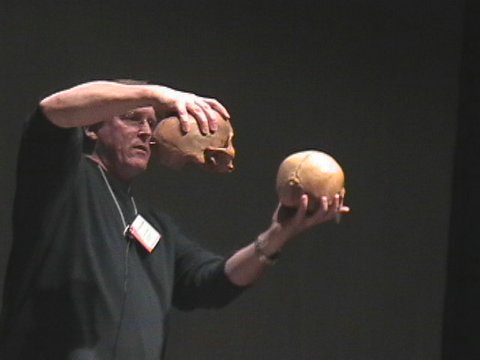
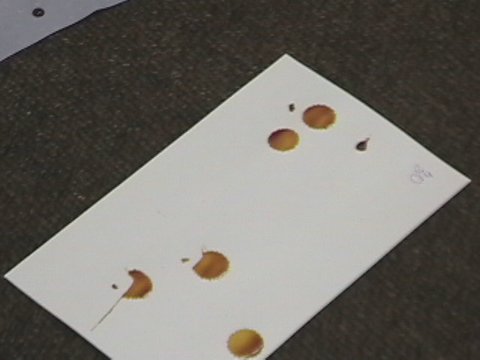
Classroom crime scene

I can't wait until next year - I'll need some time to get all the materials together, but I'm planning to set up my classroom just like the picture above.
Fake blood splatters
I had great fun investigating how crime scene investigators determined the sequence of events in gory deaths.
Update on Gabriela Ocampo.
Why are students having difficulties with math? According to one teacher:
Another teacher found similar problems among the multiply-enrolled failing students:
Siedel was Gabriela's teacher - so why did she fail?
She knew she would face another day of confusion, another day of pretending to follow along. She could hardly do long division, let alone solve for x.So, the REAL problem is that she is innumerate, not Algebra-phobic.
Why are students having difficulties with math? According to one teacher:
Shane Sauby, who worked as an attorney and stockbroker before becoming a teacher, volunteered to teach the students confronting first-year algebra for a second, third or fourth time. He thought he could reach them.Nah, I'm sure THAT wasn't the problem. It must have been the mysterious Algebra block.
But, Sauby said, many of his students ignored homework, rarely studied for tests and often skipped class.
Another teacher found similar problems among the multiply-enrolled failing students:
George Seidel, devoted a class this fall to reviewing equations with a single variable, such as x -- 1 = 36. It's the type of lesson students were supposed to have mastered in fourth grade.Look, guys, it isn't rocket science. If you don't put the effort in, you won't take the reward out.
Only seven of 39 students brought their textbooks. Several had no paper or pencils. One sat for the entire period with his backpack on his shoulders, tapping his desk with a finger.
Another doodled an eagle in red ink in his notebook. Others gossiped as Seidel, a second-year teacher, jotted problems on the front board.
Siedel was Gabriela's teacher - so why did she fail?
Seidel did not appear to make a difference with Gabriela Ocampo. She failed his class in the fall of 2004 — her sixth and final semester of Fs in algebra.Ya' think that might have made a difference?
But Gabriela didn't give Seidel much of a chance; she skipped 62 of 93 days that semester.
What need of math?
There's a raging argument going on over at Joanne Jacobs, a blog dedicated to education topics. The reason for the outcry? Richard Cohen's article about the California requirement for graduation - Algebra I:
Algebra is extremely useful. It opens up the world of symbolic logic, and is the gateway to reaching the level of what is called in the educational world, HOTS - Higher Order Thinking Skills.
Who started this uproar?
I confess to be one of those people who hate math. I can do my basic arithmetic all right (although not percentages) but I flunked algebra (once), barely passed it the second time -- the only proof I've ever seen of divine intervention -- somehow passed geometry and resolved, with a grateful exhale of breath, that I would never go near math again. I let others go on to intermediate algebra and trigonometry while I busied myself learning how to type. In due course, this came to be the way I made my living. Typing: Best class I ever took.Wrong-o, Cohen.
Here's the thing, Gabriela: You will never need to know algebra. I have never once used it and never once even rued that I could not use it. You will never need to know -- never mind want to know -- how many boys it will take to mow a lawn if one of them quits halfway and two more show up later -- or something like that. Most of math can now be done by a computer or a calculator. On the other hand, no computer can write a column or even a thank-you note -- or reason even a little bit. If, say, the school asked you for another year of English or, God forbid, history, so that you actually had to know something about your world, I would be on its side. But algebra? Please.
Gabriela, sooner or later someone's going to tell you that algebra teaches reasoning. This is a lie propagated by, among others, algebra teachers. Writing is the highest form of reasoning. This is a fact. Algebra is not.
Algebra is extremely useful. It opens up the world of symbolic logic, and is the gateway to reaching the level of what is called in the educational world, HOTS - Higher Order Thinking Skills.
Who started this uproar?
Gabriela Ocampo.Well, I have a few questions.
Last year, she dropped out of the 12th grade at Birmingham High School in Los Angeles after failing algebra six times in six semesters, trying it a seventh time and finally just despairing over ever getting it. So, according to the Los Angeles Times, she "gathered her textbooks, dropped them at the campus book room and, without telling a soul, vanished from Birmingham High School."
- Why was Gabriela still struggling with Algebra I - a freshman subject - as a senior? Does that mean that she never took any other high school math? For, that's what the pre-Algebra courses are - NOT high school math.
- How were her OTHER grades? Was she a student that just did the minimum? A "just gimme a D" student? Could she, in fact, write a coherent sentence?
- What was her high school doing about her problem? Was she given access to tutoring? How could the guidance department let her get that far without insisting she pass such a basic subject?
- Was she working as well as attending school? I know many teens do it, but if the kid is struggling with the classes, dump the job.
- Is Richard Cohen seriously suggesting that some people just can't "do math". Horse**t! It may take a special genius to invent the math, but ANY student who seriously applies themselves will be able to learn basic Algebra, Trig, and Geometry. They just have to suck it up and spend the time.
Let me just add my $.02. It should be a criminal offense for a journalist to address this issue (on any school subject) and fail to ask: "Were her teachers any good? Did they offer any tutoring? When she failed once, did they try something different the second time? And how many other students are this frustrated as well? How many of them all have the same teacher?" To add to this lack of any sort of journalistic investigation the insistence that the problem is the math, because it's just a bad old hard subject that adults almost never use in real life, is idiotic as well.
Saturday, February 11, 2006
Helping in a new way
I'm providing a link to an interesting article in the New Yorker, that asks social scientists to look at major issues, such as homelessness, in a new way.
What does this have to do with education? The ones that cause the majority of referrals, disciplinary actions, and poor scores on high-stakes tests, may be just those hard-core few. And they are being poorly served by current educational fixes. Many of them have poor reading and writing skills; some are virtually innumerate. Yet, in a typical high school, such students generally do not get the assistance they need. They aren't "special ed", they just haven't picked up the skills they need to manage to learn. They find classes a tedious and incomprehensible nuisance - as a result, they often disrupt, just to engineer an escape from the torture.
Such students might better be served in a "high school preparatory" program, that addresses their educational shortcomings. It should probably be housed in a separate facility, far from temptation to cut class and wander the hallways. No student should be in the program except the academically underpowered. It shouldn't be a dumping ground for the unruly. The goal would be to turn the students around in the shortest time possible, and might include a longer day, or even Saturday school or an extended school year.
In the nineteen-eighties, when homelessness first surfaced as a national issue, the assumption was that the problem fit a normal distribution: that the vast majority of the homeless were in the same state of semi-permanent distress. It was an assumption that bred despair: if there were so many homeless, with so many problems, what could be done to help them? Then, fifteen years ago, a young Boston College graduate student named Dennis Culhane lived in a shelter in Philadelphia for seven weeks as part of the research for his dissertation. A few months later he went back, and was surprised to discover that he couldn’t find any of the people he had recently spent so much time with. “It made me realize that most of these people were getting on with their own lives,” he said.It turned out that, by targeting the hard-core few, social services could be delivered cheaper, and, more importantly, better.
Culhane then put together a database—the first of its kind—to track who was coming in and out of the shelter system. What he discovered profoundly changed the way homelessness is understood. Homelessness doesn’t have a normal distribution, it turned out. It has a power-law distribution. “We found that eighty per cent of the homeless were in and out really quickly,” he said. “In Philadelphia, the most common length of time that someone is homeless is one day. And the second most common length is two days. And they never come back. Anyone who ever has to stay in a shelter involuntarily knows that all you think about is how to make sure you never come back.”
The next ten per cent were what Culhane calls episodic users. They would come for three weeks at a time, and return periodically, particularly in the winter. They were quite young, and they were often heavy drug users. It was the last ten per cent—the group at the farthest edge of the curve—that interested Culhane the most. They were the chronically homeless, who lived in the shelters, sometimes for years at a time. They were older. Many were mentally ill or physically disabled, and when we think about homelessness as a social problem—the people sleeping on the sidewalk, aggressively panhandling, lying drunk in doorways, huddled on subway grates and under bridges—it’s this group that we have in mind. In the early nineteen-nineties, Culhane’s database suggested that New York City had a quarter of a million people who were homeless at some point in the previous half decade —which was a surprisingly high number. But only about twenty-five hundred were chronically homeless.
It turns out, furthermore, that this group costs the health-care and social-services systems far more than anyone had ever anticipated. Culhane estimates that in New York at least sixty-two million dollars was being spent annually to shelter just those twenty-five hundred hard-core homeless.
What does this have to do with education? The ones that cause the majority of referrals, disciplinary actions, and poor scores on high-stakes tests, may be just those hard-core few. And they are being poorly served by current educational fixes. Many of them have poor reading and writing skills; some are virtually innumerate. Yet, in a typical high school, such students generally do not get the assistance they need. They aren't "special ed", they just haven't picked up the skills they need to manage to learn. They find classes a tedious and incomprehensible nuisance - as a result, they often disrupt, just to engineer an escape from the torture.
Such students might better be served in a "high school preparatory" program, that addresses their educational shortcomings. It should probably be housed in a separate facility, far from temptation to cut class and wander the hallways. No student should be in the program except the academically underpowered. It shouldn't be a dumping ground for the unruly. The goal would be to turn the students around in the shortest time possible, and might include a longer day, or even Saturday school or an extended school year.
Saturday, February 04, 2006
What's the purpose of education?
Over at Marginal Revolution, I found this pithy piece:
I view education as a self-commitment to being a more productive kind of person. Education is about self-acculturation.It's an interesting idea - that education might be more important than we realize. It's not "just the facts" that matter, but the opportunity to mold CHARACTER.
Men are born beasts. But education gives you a peer group, a self-image, and some skills as well. Getting an education is like becoming a Marine. Men need to be made into Marines. By choosing many years of education, you are telling yourself that you stand on one side of the social divide. The education itself drums that truth into you.
Similarly, if you become a Mormon or a Protestant in Central America, your life prospects go up. It is not that Mormons have learned so much more, but rather they have a different sense of self. They have a positive self-image about their destiny in life and choose a different set of peers. They also choose not to drink.
Subscribe to:
Posts (Atom)