Go see the other possibilities for the last chance to speak your mind.
Thursday, March 09, 2006
Wednesday, March 08, 2006
One of the 2 Palmettos
The new house - front view
Wednesday, February 22, 2006
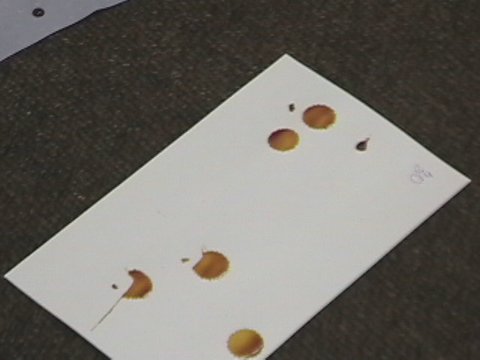
Classroom crime scene
Fake blood splatters
Update on Gabriela Ocampo.
Why are students having difficulties with math? According to one teacher:
Another teacher found similar problems among the multiply-enrolled failing students:
Siedel was Gabriela's teacher - so why did she fail?
She knew she would face another day of confusion, another day of pretending to follow along. She could hardly do long division, let alone solve for x.So, the REAL problem is that she is innumerate, not Algebra-phobic.
Why are students having difficulties with math? According to one teacher:
Shane Sauby, who worked as an attorney and stockbroker before becoming a teacher, volunteered to teach the students confronting first-year algebra for a second, third or fourth time. He thought he could reach them.Nah, I'm sure THAT wasn't the problem. It must have been the mysterious Algebra block.
But, Sauby said, many of his students ignored homework, rarely studied for tests and often skipped class.
Another teacher found similar problems among the multiply-enrolled failing students:
George Seidel, devoted a class this fall to reviewing equations with a single variable, such as x -- 1 = 36. It's the type of lesson students were supposed to have mastered in fourth grade.Look, guys, it isn't rocket science. If you don't put the effort in, you won't take the reward out.
Only seven of 39 students brought their textbooks. Several had no paper or pencils. One sat for the entire period with his backpack on his shoulders, tapping his desk with a finger.
Another doodled an eagle in red ink in his notebook. Others gossiped as Seidel, a second-year teacher, jotted problems on the front board.
Siedel was Gabriela's teacher - so why did she fail?
Seidel did not appear to make a difference with Gabriela Ocampo. She failed his class in the fall of 2004 — her sixth and final semester of Fs in algebra.Ya' think that might have made a difference?
But Gabriela didn't give Seidel much of a chance; she skipped 62 of 93 days that semester.
What need of math?
There's a raging argument going on over at Joanne Jacobs, a blog dedicated to education topics. The reason for the outcry? Richard Cohen's article about the California requirement for graduation - Algebra I:
Algebra is extremely useful. It opens up the world of symbolic logic, and is the gateway to reaching the level of what is called in the educational world, HOTS - Higher Order Thinking Skills.
Who started this uproar?
I confess to be one of those people who hate math. I can do my basic arithmetic all right (although not percentages) but I flunked algebra (once), barely passed it the second time -- the only proof I've ever seen of divine intervention -- somehow passed geometry and resolved, with a grateful exhale of breath, that I would never go near math again. I let others go on to intermediate algebra and trigonometry while I busied myself learning how to type. In due course, this came to be the way I made my living. Typing: Best class I ever took.Wrong-o, Cohen.
Here's the thing, Gabriela: You will never need to know algebra. I have never once used it and never once even rued that I could not use it. You will never need to know -- never mind want to know -- how many boys it will take to mow a lawn if one of them quits halfway and two more show up later -- or something like that. Most of math can now be done by a computer or a calculator. On the other hand, no computer can write a column or even a thank-you note -- or reason even a little bit. If, say, the school asked you for another year of English or, God forbid, history, so that you actually had to know something about your world, I would be on its side. But algebra? Please.
Gabriela, sooner or later someone's going to tell you that algebra teaches reasoning. This is a lie propagated by, among others, algebra teachers. Writing is the highest form of reasoning. This is a fact. Algebra is not.
Algebra is extremely useful. It opens up the world of symbolic logic, and is the gateway to reaching the level of what is called in the educational world, HOTS - Higher Order Thinking Skills.
Who started this uproar?
Gabriela Ocampo.Well, I have a few questions.
Last year, she dropped out of the 12th grade at Birmingham High School in Los Angeles after failing algebra six times in six semesters, trying it a seventh time and finally just despairing over ever getting it. So, according to the Los Angeles Times, she "gathered her textbooks, dropped them at the campus book room and, without telling a soul, vanished from Birmingham High School."
- Why was Gabriela still struggling with Algebra I - a freshman subject - as a senior? Does that mean that she never took any other high school math? For, that's what the pre-Algebra courses are - NOT high school math.
- How were her OTHER grades? Was she a student that just did the minimum? A "just gimme a D" student? Could she, in fact, write a coherent sentence?
- What was her high school doing about her problem? Was she given access to tutoring? How could the guidance department let her get that far without insisting she pass such a basic subject?
- Was she working as well as attending school? I know many teens do it, but if the kid is struggling with the classes, dump the job.
- Is Richard Cohen seriously suggesting that some people just can't "do math". Horse**t! It may take a special genius to invent the math, but ANY student who seriously applies themselves will be able to learn basic Algebra, Trig, and Geometry. They just have to suck it up and spend the time.
Let me just add my $.02. It should be a criminal offense for a journalist to address this issue (on any school subject) and fail to ask: "Were her teachers any good? Did they offer any tutoring? When she failed once, did they try something different the second time? And how many other students are this frustrated as well? How many of them all have the same teacher?" To add to this lack of any sort of journalistic investigation the insistence that the problem is the math, because it's just a bad old hard subject that adults almost never use in real life, is idiotic as well.
Saturday, February 11, 2006
Helping in a new way
I'm providing a link to an interesting article in the New Yorker, that asks social scientists to look at major issues, such as homelessness, in a new way.
What does this have to do with education? The ones that cause the majority of referrals, disciplinary actions, and poor scores on high-stakes tests, may be just those hard-core few. And they are being poorly served by current educational fixes. Many of them have poor reading and writing skills; some are virtually innumerate. Yet, in a typical high school, such students generally do not get the assistance they need. They aren't "special ed", they just haven't picked up the skills they need to manage to learn. They find classes a tedious and incomprehensible nuisance - as a result, they often disrupt, just to engineer an escape from the torture.
Such students might better be served in a "high school preparatory" program, that addresses their educational shortcomings. It should probably be housed in a separate facility, far from temptation to cut class and wander the hallways. No student should be in the program except the academically underpowered. It shouldn't be a dumping ground for the unruly. The goal would be to turn the students around in the shortest time possible, and might include a longer day, or even Saturday school or an extended school year.
In the nineteen-eighties, when homelessness first surfaced as a national issue, the assumption was that the problem fit a normal distribution: that the vast majority of the homeless were in the same state of semi-permanent distress. It was an assumption that bred despair: if there were so many homeless, with so many problems, what could be done to help them? Then, fifteen years ago, a young Boston College graduate student named Dennis Culhane lived in a shelter in Philadelphia for seven weeks as part of the research for his dissertation. A few months later he went back, and was surprised to discover that he couldn’t find any of the people he had recently spent so much time with. “It made me realize that most of these people were getting on with their own lives,” he said.It turned out that, by targeting the hard-core few, social services could be delivered cheaper, and, more importantly, better.
Culhane then put together a database—the first of its kind—to track who was coming in and out of the shelter system. What he discovered profoundly changed the way homelessness is understood. Homelessness doesn’t have a normal distribution, it turned out. It has a power-law distribution. “We found that eighty per cent of the homeless were in and out really quickly,” he said. “In Philadelphia, the most common length of time that someone is homeless is one day. And the second most common length is two days. And they never come back. Anyone who ever has to stay in a shelter involuntarily knows that all you think about is how to make sure you never come back.”
The next ten per cent were what Culhane calls episodic users. They would come for three weeks at a time, and return periodically, particularly in the winter. They were quite young, and they were often heavy drug users. It was the last ten per cent—the group at the farthest edge of the curve—that interested Culhane the most. They were the chronically homeless, who lived in the shelters, sometimes for years at a time. They were older. Many were mentally ill or physically disabled, and when we think about homelessness as a social problem—the people sleeping on the sidewalk, aggressively panhandling, lying drunk in doorways, huddled on subway grates and under bridges—it’s this group that we have in mind. In the early nineteen-nineties, Culhane’s database suggested that New York City had a quarter of a million people who were homeless at some point in the previous half decade —which was a surprisingly high number. But only about twenty-five hundred were chronically homeless.
It turns out, furthermore, that this group costs the health-care and social-services systems far more than anyone had ever anticipated. Culhane estimates that in New York at least sixty-two million dollars was being spent annually to shelter just those twenty-five hundred hard-core homeless.
What does this have to do with education? The ones that cause the majority of referrals, disciplinary actions, and poor scores on high-stakes tests, may be just those hard-core few. And they are being poorly served by current educational fixes. Many of them have poor reading and writing skills; some are virtually innumerate. Yet, in a typical high school, such students generally do not get the assistance they need. They aren't "special ed", they just haven't picked up the skills they need to manage to learn. They find classes a tedious and incomprehensible nuisance - as a result, they often disrupt, just to engineer an escape from the torture.
Such students might better be served in a "high school preparatory" program, that addresses their educational shortcomings. It should probably be housed in a separate facility, far from temptation to cut class and wander the hallways. No student should be in the program except the academically underpowered. It shouldn't be a dumping ground for the unruly. The goal would be to turn the students around in the shortest time possible, and might include a longer day, or even Saturday school or an extended school year.
Saturday, February 04, 2006
What's the purpose of education?
Over at Marginal Revolution, I found this pithy piece:
I view education as a self-commitment to being a more productive kind of person. Education is about self-acculturation.It's an interesting idea - that education might be more important than we realize. It's not "just the facts" that matter, but the opportunity to mold CHARACTER.
Men are born beasts. But education gives you a peer group, a self-image, and some skills as well. Getting an education is like becoming a Marine. Men need to be made into Marines. By choosing many years of education, you are telling yourself that you stand on one side of the social divide. The education itself drums that truth into you.
Similarly, if you become a Mormon or a Protestant in Central America, your life prospects go up. It is not that Mormons have learned so much more, but rather they have a different sense of self. They have a positive self-image about their destiny in life and choose a different set of peers. They also choose not to drink.
Monday, January 16, 2006
Making a REALLY BIG number understandable
It been suggested the the full cost of our war against terror (at least the Iraq part) may eventually cost $ 2 trillion dollars. It's hard to visualize that large a number, so Hit & Run asked for suggestions on putting that into clear focus. Some of the comments (warning - I don't vouch for the accuracy of the calculations - it's much too early, and I don't feel like it):
Any further suggestions?
- It's a stack of $100s 1357.32 miles high, weighing approximately 20,000 tons.
- population of USA (via google): 295,734,134
2 tril/295,734,134 = $6762.83 per person in US
population of Iraq (via google): 26,074,906
2 tril/26,074,906 = $76,702.09 per person in Iraq
We should try to break down the national debt this way - it might make people less likely to pressure their legislators to "get their share". - If you made the average US wage in 2004 it would take you a little more than 56,103,263 years to make 2T.
Had you been collecting that amount since the split of the common ancestor between apes and humans, you would be about a tenth of the way there.
At the other end, if you could buy a water molecule for each dollar, you might just be able to see it with one or two Trillion dollars(Googling I found an estimate of 10T molecules in water drop the size of a period).
Any further suggestions?
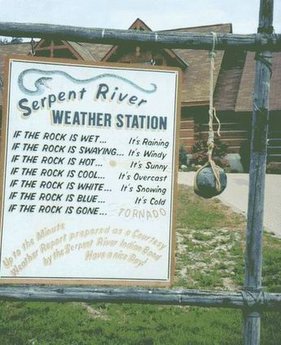
A really good way to weed out the unqualified
How do you recruit truly qualified technical people?

Found on Curmudgeonly & Skeptical.
Caution: the site is often not safe for work - view at your own risk. But, it is one of the funniest sites I regularly visit.
Found on Curmudgeonly & Skeptical.
Caution: the site is often not safe for work - view at your own risk. But, it is one of the funniest sites I regularly visit.
Thursday, January 12, 2006
Helping students to understand science texts
While checking out the Carnival of Education, I found a gem from Ms. Frizzle's blog. Ms. Frizzle is a scienc teacher from the Bronx, whose adventures provide much enlightenment and entertainment (most of it coming from her descriptions of the bureaucratic hassles she encounters).
Ms. Frizzle invented a method to help students learn how to read science texts.
I know I'm going to try this out today. I'll post later this week how it worked.
Ms. Frizzle invented a method to help students learn how to read science texts.
I realized that I needed to model notetaking for them, possibly by showing them several examples of notes on the same passage, and having them discuss which ones would be most useful for studying at a later point.She goes on to detail just how she manages the process of helping her students to "de-code" the text.
As I began thinking about today's lesson - another reading-oriented lesson, this time about machines & mechanical advantage - I realized that there are several aspects to successful content-area literacy. The goal is that the students will be able to learn new material from a text with little support from the teacher. The first thing they need to be able to do is figure out what's important in the text. Then they need to be able to reflect on it and play with it in their heads until they are sure they understand it. Finally, they need to write down the most important points and whatever supporting details they need in order to remember and review it later on.
I know I'm going to try this out today. I'll post later this week how it worked.
Saturday, January 07, 2006
Instructional Day
Wednesday, January 04, 2006
My new technology
I received an MP3 player for Christmas - not the famous Apple IPod, which always seemed to me like a walking advertisment that the owner knew squat about tech. It wasn't completely intuitive to get started using (of course, I didn't bother with the directions), but within a short time, I was enjoying listening to music and books on tape without carrying around a bulky CD player. I'm hoping that I can make use of it while exercising; I certainly need the workout.
At school, yesterday we had an Instructional Fair. My department head and I showed teachers our new Quizdom setup. Afterwards, the feedback was terrific. I've heard from a good 1/2 dozen people that we did a fine job. Nice to hear it, though.
I've been exploring our school's eChalk site. It's at Wade Hampton High School. You can search for my page, then click on the individual class pages to see what I'm talking about. One peeve I have is that updates are slow to load. However, I can see that it's a useful tool for the newbie to manage. And, I can see that it would be easy to set up a group for the Science Department, the 9th grade Academy, etc. I might just do that.
A news feed I've been enjoying lately is Tech Central Station, which primarily focuses on the impact of technology on life and society, but goes into interesting topics such as the effect of life extension on populations, or drug development and the currently litigious climate.
At school, yesterday we had an Instructional Fair. My department head and I showed teachers our new Quizdom setup. Afterwards, the feedback was terrific. I've heard from a good 1/2 dozen people that we did a fine job. Nice to hear it, though.
I've been exploring our school's eChalk site. It's at Wade Hampton High School. You can search for my page, then click on the individual class pages to see what I'm talking about. One peeve I have is that updates are slow to load. However, I can see that it's a useful tool for the newbie to manage. And, I can see that it would be easy to set up a group for the Science Department, the 9th grade Academy, etc. I might just do that.
A news feed I've been enjoying lately is Tech Central Station, which primarily focuses on the impact of technology on life and society, but goes into interesting topics such as the effect of life extension on populations, or drug development and the currently litigious climate.
Thursday, December 29, 2005
Back from semi-hiatus
It's Winter Christmas Break, and I'm semi-caught up on home organizing. Alas, the grading is still looming, but I'll tackle that later, when I'm properly fortified with food.
There's an interesting discussion going on over at Going to the Mat, about whether there are too many people in college, and what the utility of a college degree is today. One provocative comment suggested that government stop funding the liberal arts degree with loans and grants. I think the idea has merit, but I doubt that it will fly past Congress. Or do they have to approve a rules change like that?
I think you could make a good argument for phasing out subsidies/grants/loans for liberal arts majors over a few years. If people want to study liberal arts, let them pay for it. Then, use 1/2 the money saved for increasing funding in math, engineering, and science.
There's an interesting discussion going on over at Going to the Mat, about whether there are too many people in college, and what the utility of a college degree is today. One provocative comment suggested that government stop funding the liberal arts degree with loans and grants. I think the idea has merit, but I doubt that it will fly past Congress. Or do they have to approve a rules change like that?
I think you could make a good argument for phasing out subsidies/grants/loans for liberal arts majors over a few years. If people want to study liberal arts, let them pay for it. Then, use 1/2 the money saved for increasing funding in math, engineering, and science.
Wednesday, December 21, 2005
All I want for Christmas is....
I know that I can't effortlessly count in binary, the language of this clock, but I want one.
Amazon has a really good idea. They organized their gift suggestions by magazine - each editor has a clickable picture of the magazine that leads to gift ideas for the readers. I checked it out, and it's nice. Good idea for that hard-to-buy-for person - as long as you know what magazines he/she reads.
Tsunami X Blaster Motorized Water Gun
Or, even better:
The Robo Raptor - hey, it's only $99.00! I was playing around with it last Friday, and it is a pretty good toy.
The above available at Radio Shack.
Sunday, December 11, 2005
Fun definition
Found on One Cosmos
Bilingual education involves the difficult achievement of learning nothing in two languages.
Wednesday, December 07, 2005
Nearly done!
I just found the information about a course I took through the University of Hawaii at Manoa in the 90s, that puts me over the top for getting my full certification status. They're issuing me a temporary certificate, with a permit to teach out of field. Once they receive the last 3 credits, I'm in for the full certificate.
At last!
If there is a lesson for all of us, it's keep the paperwork together. It took me months to pull all the information from my fast-fading memory cells. I've been attending classes and workshops for the last 17 years, since I first was certified. I never had to scramble for credits to renew. Usually, I had all the credits in the first year to renew four years later. Often, I was too cheap to pay for the credit, and just by-passed the chance.
Never more. It was a tight squeak, but I made it. Credits, Praxis, and all.
Christmas is going to be VERY, VERY good this year.
At last!
If there is a lesson for all of us, it's keep the paperwork together. It took me months to pull all the information from my fast-fading memory cells. I've been attending classes and workshops for the last 17 years, since I first was certified. I never had to scramble for credits to renew. Usually, I had all the credits in the first year to renew four years later. Often, I was too cheap to pay for the credit, and just by-passed the chance.
Never more. It was a tight squeak, but I made it. Credits, Praxis, and all.
Christmas is going to be VERY, VERY good this year.
Saturday, December 03, 2005
The most important scientific discoveries
On Viking Pundit, Eric posted a list of the most important scientific discoveries of the 20 century. Read the list, and see if you agree with Physicist Alan Lightman.
Thursday, December 01, 2005
Saturday, November 19, 2005
Virtue may be its own reward, but...
I've been a very good girl today, spend a good portion of the day grading and planning for the semester mid-term, so I could indulge myself with some free time blogging.
Which I am enjoying right now.
Sunday, November 13, 2005
New Blogger for Word
I’m trying out the new Blogger for Word.
It’s a quick add-on, that has features that make it work well for me. But the biggest advantage is that I can write my posts, then upload them at one time when I have a connection. That means I’ll be able to do more blogging in my free time during the day, instead of trying to compose at night, when I’m more tired.
We should be getting a faster connection this week, probably cable. That will make working on projects MUCH easier, not to mention the ease of keeping up on news.
It’s a quick add-on, that has features that make it work well for me. But the biggest advantage is that I can write my posts, then upload them at one time when I have a connection. That means I’ll be able to do more blogging in my free time during the day, instead of trying to compose at night, when I’m more tired.
We should be getting a faster connection this week, probably cable. That will make working on projects MUCH easier, not to mention the ease of keeping up on news.
Sunday, November 06, 2005
Saturday, November 05, 2005
Adult Science Fair Project
As we head into the Science Fair project season, I thought you'd like this link, which might be useful to contemplate after you've come home, late in the evening, after the final judging. You might actually conduct the experiment, if you're really fried.
Update - amost forgot to mention where I got the link. The Vodkapundit, of course.
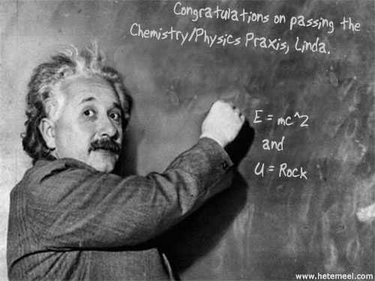
Even Einstein agrees!
This is S-O-O-O cool! You click on the link, and you can write whatever message you want on the blackboard. The picture is then saved, and you can use is to give the Ultimate Nerd Imprimatur to your favorite person.
How cool is that?
In my excitement about finding this new toy, I totally forgot to credit the blogger who directed me to the site - Kevin McGehee. Sorry, Kev.
How cool is that?
In my excitement about finding this new toy, I totally forgot to credit the blogger who directed me to the site - Kevin McGehee. Sorry, Kev.
Friday, November 04, 2005
Another update on the SCSC
This is the last day of the South Carolina Science Council conference. As usual, I'm tired and just about ready to get home and get back to my regular life, and yet...
This was a very productive conference. I came with my department head, and another teacher in the building. Together, we planned out our days to maximize our time. We made sure that no workshop went uncovered if we needed to find out more about the topic. We were at workshops on content, labs, and the new science standards from the state. We also took time to check out the exhibits, and find out what's new in the technology.
I had new responsibilities, as I will be issued my certification soon for Chemistry & Physics, and need to touch base with the professional organizations, expand my knowledge base, and, frankly, get all the help that I can before I start teaching those subjects next year.
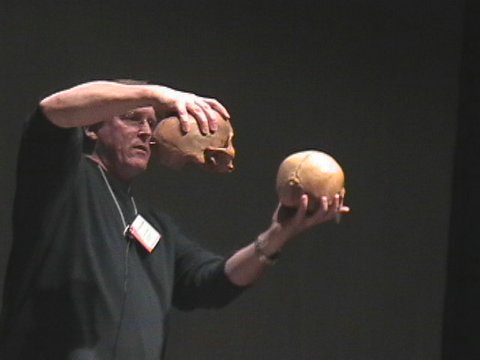
Last night, as you can see from the photos below, we also took the time to relax and enjoy the local sights. While I was there, I had an interesting conversation with Dr. Jeff Goldstein, the Center Director, National Center for Space, Earth, and Flight Science Education. He and I discussed Bill Nye's Keynote address, which touched on the need to teach students the difference between science, which is testable, and theories in religion and philosophy, which are not. We spent some time wrestling with how to approach the subject, and the role of the professional organizations in addressing the issue, admittedly a touchy and polarizing subject in many communities.

Dr. Goldstein will be the featured speaker today at the closing meeting of the conference. I'll take some notes, and post when I return home.
This was a very productive conference. I came with my department head, and another teacher in the building. Together, we planned out our days to maximize our time. We made sure that no workshop went uncovered if we needed to find out more about the topic. We were at workshops on content, labs, and the new science standards from the state. We also took time to check out the exhibits, and find out what's new in the technology.
I had new responsibilities, as I will be issued my certification soon for Chemistry & Physics, and need to touch base with the professional organizations, expand my knowledge base, and, frankly, get all the help that I can before I start teaching those subjects next year.
Last night, as you can see from the photos below, we also took the time to relax and enjoy the local sights. While I was there, I had an interesting conversation with Dr. Jeff Goldstein, the Center Director, National Center for Space, Earth, and Flight Science Education. He and I discussed Bill Nye's Keynote address, which touched on the need to teach students the difference between science, which is testable, and theories in religion and philosophy, which are not. We spent some time wrestling with how to approach the subject, and the role of the professional organizations in addressing the issue, admittedly a touchy and polarizing subject in many communities.
Dr. Goldstein will be the featured speaker today at the closing meeting of the conference. I'll take some notes, and post when I return home.
Thursday, November 03, 2005
New Link on the Blogroll
I've a new link, WulfTheTeacher, a thoughtful Physics teacher with some interesting observations on the practice of teaching. He's another southern teacher, from Richmond, VA. I've heard about the Standards of Learning in VA (sometimes the teachers use the abbreviation a little ironically) from workshop participants in the PTRA program.
Welcome to the list, Wulf.
By the sea, by the sea...
I'm in sunny Myrtle Beach right now. There's a state science convention being held here, and, you know me, if there's fun, I'm there. I'll be there through Friday.
I was smart enough to take my laptop with me, and there's wireless access in the hotel, so I'll have some time to catch up on posting. I'll have more time in the future at home, since...
I PASSED THE PRAXIS II IN CHEMISTRY/PHYSICS/GENERAL SCIENCE. TA-DAAAAA!
Honestly, after the mix-up with the test booklet and the answer booklet, I was increasingly sure I failed. It took about 2 weeks longer than usual to get the scores to me. Now, mind you, I passed, barely! But, as many a coach will tell the team, even an ugly win is a win. I'll take it.
I'm looking forward to getting to know the science teachers in this state, and learning more about the issues that they are facing. In SC, we have an End of Course Test in Physical Science, which is, by state mandate, 20% of the students' final grade. Unless they have a fairly high grade, a failing grade on that test means they fail the course, which means they get no credit for the course. So, this is indeed a high-stakes test.
I've volunteered to help with the Science Club, and we've decided to enter the science Olympiad. If anyone has any experience with that, could you email me? I could use some guidance on how to prepare a team.
Now, I'm off to eat, and register for the conference. I'll post later, hopefully with lots of pictures.
I was smart enough to take my laptop with me, and there's wireless access in the hotel, so I'll have some time to catch up on posting. I'll have more time in the future at home, since...
I PASSED THE PRAXIS II IN CHEMISTRY/PHYSICS/GENERAL SCIENCE. TA-DAAAAA!
Honestly, after the mix-up with the test booklet and the answer booklet, I was increasingly sure I failed. It took about 2 weeks longer than usual to get the scores to me. Now, mind you, I passed, barely! But, as many a coach will tell the team, even an ugly win is a win. I'll take it.
I'm looking forward to getting to know the science teachers in this state, and learning more about the issues that they are facing. In SC, we have an End of Course Test in Physical Science, which is, by state mandate, 20% of the students' final grade. Unless they have a fairly high grade, a failing grade on that test means they fail the course, which means they get no credit for the course. So, this is indeed a high-stakes test.
I've volunteered to help with the Science Club, and we've decided to enter the science Olympiad. If anyone has any experience with that, could you email me? I could use some guidance on how to prepare a team.
Now, I'm off to eat, and register for the conference. I'll post later, hopefully with lots of pictures.
Sunday, October 23, 2005
A movable whiteboard
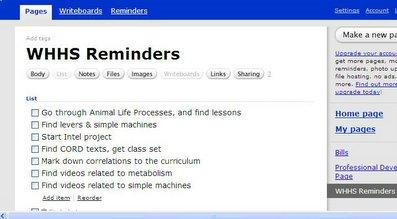
I've found a new web application that I think is "da bomb". It has two parts - one is a shareable "whiteboard", the other a web-accessible planning tool.
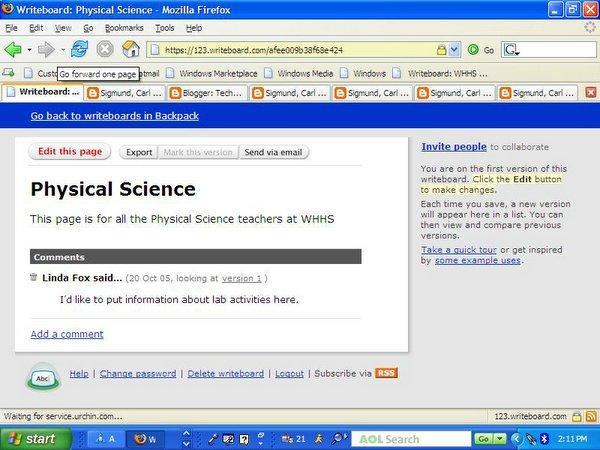
You can see a sample here. If you sign in for the planner, you can then create a whiteboard. I've made one to share with the other science teachers at my school. (see the example on the post above)
The whiteboards are a neat idea, particularly when you don't share common planning time, or are working with someone in a different time zone. (2nd example above)
You can see a sample here. If you sign in for the planner, you can then create a whiteboard. I've made one to share with the other science teachers at my school. (see the example on the post above)
The whiteboards are a neat idea, particularly when you don't share common planning time, or are working with someone in a different time zone. (2nd example above)
Saturday, October 08, 2005
CHECK THIS OUT
United Learning has a really cool service. It provides video on demand to your desktop.
The state of South Carolina has bought a 3 year subscription for all schools in the state. The catch is, the teachers have to actually use it. If they don't make use of it, SC may not fund it anymore. So, if you work in SC, find out about it, and actually use it on a regular basis (PLEASE!)
I've already shown some of the videos in my science classes. They range from relatively short (15-20 minutes) to around an hour. They have been decent quality, aligned to the state standards, and have associated teacher's guides.
Think about it. As teachers, we're always trying to find good, visually-oriented instructional resources. We know today's kids are visual, not text-oriented. And the school or local library can't possibly stock a wide enough range of videos to suit us.
Enter the video on demand service. For a set fee, you can have a searchable index of classroom-ready videos. With a projection screen or an digital-to-analog converter for your TV, you can provide virtually unlimited access to teachers.
The state of South Carolina has bought a 3 year subscription for all schools in the state. The catch is, the teachers have to actually use it. If they don't make use of it, SC may not fund it anymore. So, if you work in SC, find out about it, and actually use it on a regular basis (PLEASE!)
I've already shown some of the videos in my science classes. They range from relatively short (15-20 minutes) to around an hour. They have been decent quality, aligned to the state standards, and have associated teacher's guides.
Think about it. As teachers, we're always trying to find good, visually-oriented instructional resources. We know today's kids are visual, not text-oriented. And the school or local library can't possibly stock a wide enough range of videos to suit us.
Enter the video on demand service. For a set fee, you can have a searchable index of classroom-ready videos. With a projection screen or an digital-to-analog converter for your TV, you can provide virtually unlimited access to teachers.
Thursday, September 29, 2005
INNOVATIVE FAILURES
I found this site on Dean's World, a blog that I'm very fond of (yes, I realize that I ended that sentence on a preposition - live with it).
I'm thinking that the links could be best used as a springboard to a discussion that allows students to talk about their (mis)conceptions of basic physics principles. For the more advanced students, each could take a device, and write and present a report about the reasons why they wouldn't work.
Wednesday, September 28, 2005
APPROPRIATE USE OF TECHNOLOGY
I found the above post on The Education Wonks Carnival of Education.
I agree that many of the computers that are sitting in classrooms all over the US are not being fully utilized. But, I can and do disagree that the problem with full implementation lies with unaware teachers. A far bigger problem is that a desktop computer, by itself, is not as helpful as TARGETED TECHNOLOGY.
What is targeted technology?
For the Math teacher, it's 1 computer, and a class set of graphing calculators. Along with some type of projection system that will let him/her show the students what he/she is putting into his calculator, and how it should look when he/she does. That projection can run from around $300 - $3,000. Better that ALL math teachers in the district get a low-end system, than a few get the bells and whistles, and the rest nothing. That last situation is too often the case. Administrators are often impressed by the Porsche systems.
For the English teacher, it might be computers, laptops (to enable students without one to check them out overnight), or, for the relatively low-end solution, the AlphaSmart. The AlphaSmart additionally is less likely to be ripped off.
For the Science teacher, it's 10 graphing calculators, along with probeware to collect data on. Along with a hefty budget for training. The electronic stuff has a steep learning curve. If you have some equipment sitting, and no idea how to use it, go to the PTRA site, and look into booking a workshop. They work. I know. That's how I was trained.
Tech is not a one-size-fits-all proposition. The amounts needed to different teachers may be different. The egalitarian may complain about that.
Tough.
There is nothing more infuriating to me than equipment not being used, still sitting on someone's desk, just because it's "fair".
No, it's not. If the teacher won't make the effort to learn how to use it, take it away, and give it to someone who will. Unused, it's becoming more obsolete by the minute.
Much has been written about the inequity of the availability of computers and communications tools between different schools. However, the digital divide between teachers exists even in technology rich schools. As Will points out, there are many teachers who have no idea of the power and potential already sitting in their own classrooms.
So, is it possible to help these teachers move faster in their understanding of how to best use what they have - maybe before the next wave of innovation hits? I agree with Will that it’s going to be difficult to impossible as the gap continually widens.

I agree that many of the computers that are sitting in classrooms all over the US are not being fully utilized. But, I can and do disagree that the problem with full implementation lies with unaware teachers. A far bigger problem is that a desktop computer, by itself, is not as helpful as TARGETED TECHNOLOGY.
What is targeted technology?
For the Math teacher, it's 1 computer, and a class set of graphing calculators. Along with some type of projection system that will let him/her show the students what he/she is putting into his calculator, and how it should look when he/she does. That projection can run from around $300 - $3,000. Better that ALL math teachers in the district get a low-end system, than a few get the bells and whistles, and the rest nothing. That last situation is too often the case. Administrators are often impressed by the Porsche systems.
For the English teacher, it might be computers, laptops (to enable students without one to check them out overnight), or, for the relatively low-end solution, the AlphaSmart. The AlphaSmart additionally is less likely to be ripped off.
For the Science teacher, it's 10 graphing calculators, along with probeware to collect data on. Along with a hefty budget for training. The electronic stuff has a steep learning curve. If you have some equipment sitting, and no idea how to use it, go to the PTRA site, and look into booking a workshop. They work. I know. That's how I was trained.
Tech is not a one-size-fits-all proposition. The amounts needed to different teachers may be different. The egalitarian may complain about that.
Tough.
There is nothing more infuriating to me than equipment not being used, still sitting on someone's desk, just because it's "fair".
No, it's not. If the teacher won't make the effort to learn how to use it, take it away, and give it to someone who will. Unused, it's becoming more obsolete by the minute.
Saturday, September 24, 2005
Monday, September 12, 2005
MODELING PHYSICS
The Modeling program at Arizona State University is ot of funds, and its future is uncertain. But the influence of the program continues.
I was fortunate enough to attend the program in 2004. Due to budget constraints, I wasn't able to go this year. I've been lucky enough to have landed a job this year, teaching Physical Science, and I'm finally putting the modeling concepts into practice.
One major difference is that I plan more time at the back end of a lab. It takes time to de-brief the students about their findings. I'm also answering questions with "what do you think?" as a matter of course. It can be infuriating for the student, at first. They're used to getting a quick, decisive answer from their teachers. But, in time, they learn to stop leaning on the teacher for questions they could jolly well answer themselves, with a little thought.
I also spend more time designing my lessons. For example, today I was planning to move right into acceleration. But, on reflection, I decided to re-visit constant velocity, and then move into increasing velocity with the same equipment.
I'm a little hampered by an embarassing lack of stopwatches. For some reason, all of ours are kaput - apparently, since the last time someone used them, they've run out of battery power. I passed the info to my department head, and she's ordering the MyChrono timers. I've used them before, and they're sturdy and relatively cheap.
My kids may have to use the TI-83, with a LabPro and motion detector. I'll have to play around with the equipment tomorrow, to make sure I have all the parts powered.
I've been using the Ranking Tasks lately. It makes a good review of the concepts, and is a quick check on understanding. It also takes almost no time to grade, which I VERY much like.
I was fortunate enough to attend the program in 2004. Due to budget constraints, I wasn't able to go this year. I've been lucky enough to have landed a job this year, teaching Physical Science, and I'm finally putting the modeling concepts into practice.
One major difference is that I plan more time at the back end of a lab. It takes time to de-brief the students about their findings. I'm also answering questions with "what do you think?" as a matter of course. It can be infuriating for the student, at first. They're used to getting a quick, decisive answer from their teachers. But, in time, they learn to stop leaning on the teacher for questions they could jolly well answer themselves, with a little thought.
I also spend more time designing my lessons. For example, today I was planning to move right into acceleration. But, on reflection, I decided to re-visit constant velocity, and then move into increasing velocity with the same equipment.
I'm a little hampered by an embarassing lack of stopwatches. For some reason, all of ours are kaput - apparently, since the last time someone used them, they've run out of battery power. I passed the info to my department head, and she's ordering the MyChrono timers. I've used them before, and they're sturdy and relatively cheap.
My kids may have to use the TI-83, with a LabPro and motion detector. I'll have to play around with the equipment tomorrow, to make sure I have all the parts powered.
I've been using the Ranking Tasks lately. It makes a good review of the concepts, and is a quick check on understanding. It also takes almost no time to grade, which I VERY much like.
Thursday, September 08, 2005
PROGRESS REPORTS & GRADING
I've just finished the first progress reports entry onto the computer since I came to SC. I must admit, the programming makes it relatively easy, even for the newbie (i.e., me) to complete.
Grading and such are probably my least favorite part of teaching. Too often, I put it off until the ungraded work threatens to take over my lab table. Then, I usually complete the job in a frenzy of activity, then go home and have a stiff drink (or two). Although, the grades might be more generous if I had the drinks first.
This year, I've been using the lab notebook method. About seventy percent of what I grade is written in the notebook, which I collect about once a week. By staggering the collection schedule, I've kept the notebook grading from becoming an overwhelming task. I only grade about 20 notebooks, max, a day.
When I grade, I look for specific details - have they structured the report in the way I spelled out at the beginning of the year? Does their data table make sense? Is their graph on graph paper (stapled or taped into the notebook, hinge fashion, folded)? Is the graph "good" - scaled appropriately, labeled, clearly showing a trend that relates to the data, visually appealing? That last I encourage by occasionally making a copy of the graph, and using it on the bulletin board or web site as a good example. It spurs them to improve their graphing skills. To me, that's important; they come to realize that graphs are the favored form of communication for scientists. I like to think of it as improving their communication skills.
The rest of the grade comes from observation in labs (for that, I use a checklist - it keeps them on task), whiteboard reports, and tests/quizzes.
Grading and such are probably my least favorite part of teaching. Too often, I put it off until the ungraded work threatens to take over my lab table. Then, I usually complete the job in a frenzy of activity, then go home and have a stiff drink (or two). Although, the grades might be more generous if I had the drinks first.
This year, I've been using the lab notebook method. About seventy percent of what I grade is written in the notebook, which I collect about once a week. By staggering the collection schedule, I've kept the notebook grading from becoming an overwhelming task. I only grade about 20 notebooks, max, a day.
When I grade, I look for specific details - have they structured the report in the way I spelled out at the beginning of the year? Does their data table make sense? Is their graph on graph paper (stapled or taped into the notebook, hinge fashion, folded)? Is the graph "good" - scaled appropriately, labeled, clearly showing a trend that relates to the data, visually appealing? That last I encourage by occasionally making a copy of the graph, and using it on the bulletin board or web site as a good example. It spurs them to improve their graphing skills. To me, that's important; they come to realize that graphs are the favored form of communication for scientists. I like to think of it as improving their communication skills.
The rest of the grade comes from observation in labs (for that, I use a checklist - it keeps them on task), whiteboard reports, and tests/quizzes.
Sunday, September 04, 2005
Subscribe to:
Posts (Atom)